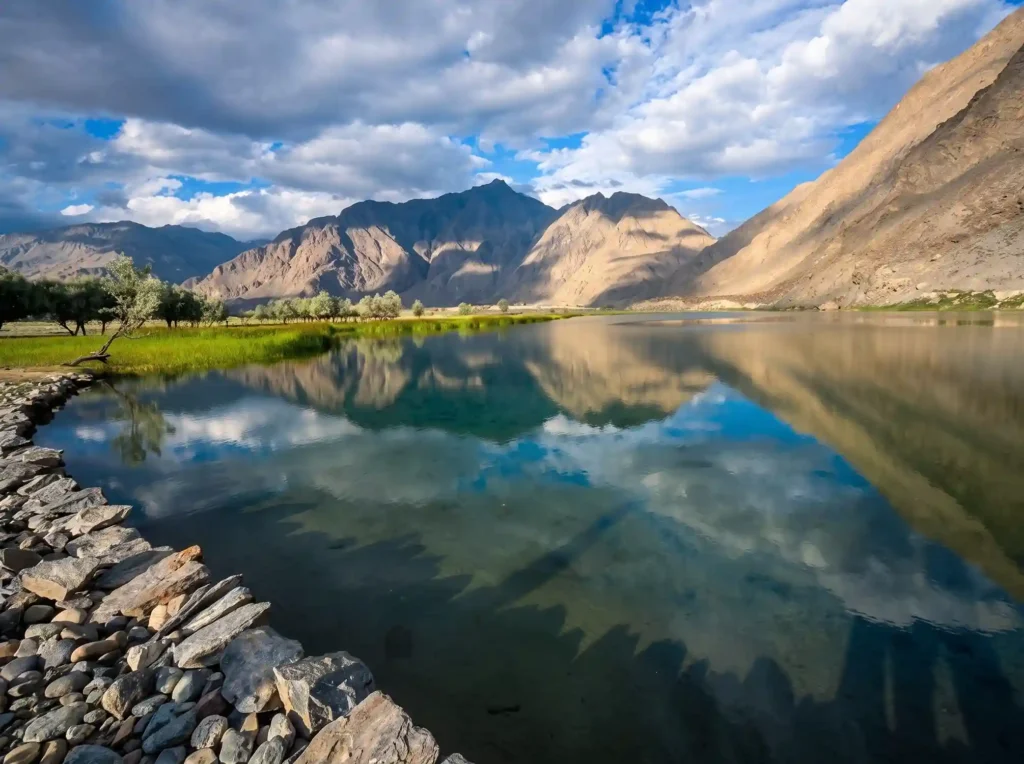
Buddha Rock Skardu, also known as Manthal Buddha Rock, is a large granite boulder carved with an image of a meditating Buddha, standing in Manthal village on the southern edge of Skardu town in Gilgit-Baltistan. The carving is one of the clearest surviving pieces of evidence that Baltistan was a Buddhist region for several centuries before Islam became the dominant faith here, and it remains one of the few sites in Skardu where a visitor can stand in front of something that has not moved, and has barely changed, in well over a thousand years. Most travelers see it as part of a short sightseeing loop that also takes in Satpara Lake, Kharpocho Fort, and Skardu Bazaar, since all four sit within a few kilometers of each other and can comfortably be covered in half a day. This guide explains where Buddha Rock Skardu is, what the carving actually shows, why it matters historically, and how to plan a visit, whether you are arranging your own transport or booking a half-day tour through Ilyas Skardu Travels and Tours.
Buddha Rock Skardu Tour Overview
Manthal village sits just south of Skardu’s built-up center, on the route that leaves town toward Satpara Lake and, further on, the Deosai Plains. Buddha Rock Skardu stands close to the left bank of the Sadpara stream, roughly three kilometers off the main Sadpara Road, in a patch of open ground that has views back toward the Indus valley and the mountains ringing Skardu. The rock itself is a naturally occurring granite boulder rather than a built monument, which is part of what makes it easy to miss if you are not specifically looking for it. There is no grand gateway or visitor complex here. A low boundary walls, a caretaker’s shelter, and a small signboard mark the site, and the carving is viewed at close range, standing a few feet from the rock face.
For a first-time visitor, the appeal of Buddha Rock Skardu is less about scale and more about context. Skardu today is known almost entirely for its lakes, cold desert, and access to K2 and the Karakoram peaks, so it is easy to forget that the region was a Buddhist center for several centuries, sitting on trade and pilgrimage routes that connected it to Kashmir, Ladakh, and Central Asia. This carving is one of the clearest physical reminders of that period. A visit typically takes twenty to thirty minutes at the site itself, which is why most itineraries pair it with Satpara Lake (on the same road), Kharpocho Fort, and a walk through Skardu Bazaar, turning it into a half-day loop rather than a single-stop excursion. The route suits families, couples, and history-focused travelers equally well, since none of the stops involve strenuous walking, though Kharpocho Fort does require a short uphill climb described later in this guide.
Quick Tour Facts
| Detail | Information |
| Site name | Manthal Buddha Rock (Buddha Rock Skardu) |
| Location | Manthal village, off Sadpara Road, Skardu Tehsil, Gilgit-Baltistan |
| Approximate distance from Skardu city | Around 3–5 km from central Skardu; roughly 3 km off the main Sadpara Road |
| Tour duration | Half day (2–4 hours, including Satpara Lake and Kharpocho Fort) |
| Tour type | Historical sightseeing and photography |
| Departure point | Skardu City |
| Return point | Skardu City |
| Transport | Private car, taxi, or tour vehicle |
| Entry fee | No official government-fixed ticket; a small local caretaker fee is sometimes collected on site (confirm current status on arrival) |
| Best time to visit | April to October |
| Difficulty level | Easy, minimal walking on level ground |
| Minimum travelers | 1 |
| Accommodation | Hotels and guesthouses in Skardu city |
| Price | Contact Ilyas Skardu Travels and Tours for current pricing |
Detailed Itinerary
Stop 1: Skardu City to Manthal (Buddha Rock) The half-day tour begins with pickup from your Skardu hotel or guesthouse. The drive to Manthal village follows Sadpara Road, the same route used to reach Satpara Lake and, eventually, Deosai. Depending on where you are staying in Skardu, this leg takes roughly fifteen to twenty-five minutes by private vehicle. At the rock, allow twenty to thirty minutes to view the carving, read the on-site information where available, and take photographs. Because the site sees far fewer visitors than Skardu’s lakes, it is common to have the carving largely to yourself outside peak holiday weekends.
Stop 2: Satpara Lake from Manthal, the vehicle continues a short distance further along Sadpara Road to Satpara Lake, a natural high-altitude lake sitting at roughly 2,600 to 2,650 meters above sea level. This stop usually runs forty-five minutes to an hour, enough time for a short walk along the shoreline, a rowboat rides if boats are operating that day, and photographs of the lake’s small island and the Karakoram peaks reflected in the water. Trout fishing is possible here for travelers who arrange it in advance, since the lake is stocked with brown and rainbow trout.
Stop 3: Kharpocho Fort the route then returns toward Skardu town to Kharpocho Fort, the 16th-century hilltop fortress associated with the Maqpon dynasty ruler Ali Sher Khan Anchan. Reaching the fort involves a twenty to forty-minute uphill walk on a stone-paved trail starting near the main bazaar, so comfortable shoes are worth having in the vehicle for this stop. The reward is a wide view over Skardu town, the Indus River, and the surrounding cold desert, which is one of the better vantage points in the valley, especially in late afternoon light.
Stop 4: Skardu Bazaar the tour closes with time in Skardu Bazaar, the town’s central commercial area, where travelers can browse local handicrafts, dried apricots and walnuts, Balti caps, and semi-precious stones for which the region is known, and try local dishes such as mamtu (steamed dumplings) or apricot-based dishes at one of the small local restaurants. This final stop is unhurried and works well as a natural end point before returning to your hotel.
Because timing depends on road conditions, group pace, and how long each traveler wants at the lake or the fort, treat the schedule above as a flexible half-day framework rather than a fixed timetable. Ilyas Skardu Travels and Tours can adjust the order of stops or extend the day to include Lower Kachura (Shangrila) Lake for travelers who want a fuller day rather than a half day.
Best Time to Visit / Seasonal Notes
The wider Skardu tourist season runs from April to October, and Buddha Rock Skardu is accessible throughout that window since it sits at a relatively low elevation on an all-season road close to town, unlike higher routes such as Deosai, which only opens between June and September. Within that April–October window, conditions still vary noticeably by month:
- Spring (April–May): Daytime temperatures are mild, roughly in the mid-teens Celsius, with cooler mornings. This is apricot and cherry blossom season in the lower Skardu valley, which adds color to the drive out to Manthal, though some higher-altitude routes nearby may still have residual snow.
- Summer (June–August): The warmest and busiest months, with daytime highs commonly in the low-to-mid twenties Celsius in Skardu town. This is peak tourist season, so Satpara Lake and Kharpocho Fort see the most visitors, though Buddha Rock itself remains quiet even in summer. Light monsoon-related rain can occur but rarely disrupts a half-day sightseeing plan.
- Autumn (September–October): Many regular visitors consider this the most comfortable stretch for sightseeing, with clearer skies, crisp air, and golden autumn color in the poplar and orchard trees around Manthal and the lower valley. Crowds thin out noticeably after early September.
- Winter (November–March): Skardu turns cold, with average temperatures well below freezing in December and January, and many hotels and services scale back. The road to Manthal generally stays open since it is close to town, but winter travel to Skardu overall is harder because flights become more weather-dependent and the Karakoram Highway can face temporary closures from snow or landslides. Winter sightseeing at Buddha Rock is possible for travelers already in Skardu, but it is not the season this half-day tour is designed around.
If your main goal is combining Buddha Rock with Satpara Lake, Kharpocho Fort, and the bazaar in comfortable weather, April through June or September through mid-October generally offer the best balance of good conditions and smaller crowds.
Cost, Inclusions, and Exclusions
Pricing for the Buddha Rock Skardu half-day tour depends on group size, vehicle type, and whether it is combined with additional stops such as Lower Kachura Lake. Contact Ilyas Skardu Travels and Tours directly for current pricing, since rates can shift with fuel costs, season, and vehicle availability.
Because informal, small entry charges are sometimes collected by local caretakers at Buddha Rock and similar heritage sites, it is worth carrying a small amount of cash in Pakistani rupees and confirming the current arrangement with your guide or driver on the day of the visit.
Getting There / Transportation
Reaching Skardu itself: Most travelers arrive in Skardu either by air or by road. Flights from Islamabad to Skardu take roughly forty-five minutes to an hour and are the fastest option, though schedules are weather-dependent and more reliable during the April–October season. The overland route follows the Karakoram Highway from Islamabad through Abbottabad, Besham, Chilas, and Gilgit before joining the Skardu Road; this journey commonly takes twenty to twenty-four hours of total driving time, usually broken into two days with an overnight stop, and offers dramatic mountain scenery along the way, including views of Nanga Parbat near Raikot Bridge. Travelers already in Gilgit can reach Skardu in roughly four to seven hours by road along the Indus.
Reaching Buddha Rock from Skardu city: Once in Skardu, the site is a short, straightforward drive. From the city center, take Sadpara Road, the same route that leads toward Satpara Lake and Deosai. Manthal village and the turn-off to the rock are reached before the lake itself, roughly three kilometers off the main road. The road surface on this stretch is sealed and manageable for any private car or taxi; a 4×4 is not required for this specific leg, unlike routes to Deosai or Shigar. There is no public transport running directly to the site, so a private car, taxi, or an organized half-day tour is the practical way to visit.
Recommended Skardu Tour Packages for Every Traveler
Explore our recommended Skardu tour packages, carefully designed for solo travelers, families, couples, and groups. Choose from flexible Budget, Standard, and Luxury options to match your travel style and budget.
| Tour(s) | Mode of Transport | Budget | Standard | Luxury |
|---|---|---|---|---|
| 5-Day Trip to Skardu: A Complete 5 Days 4 Nights Itinerary | By Road | PKR 90,500 | PKR 115,000 | PKR 194,000 |
| Hunza Tour Package | By Air | PKR 100,500 | PKR 140,500 | PKR 220,000 |
| Blind Lake Skardu Tour: A Half-Day Trip Through Shigar Valley | By Road | PKR 9,500 | PKR 12,500 | PKR 15,000 |
| Baltit Fort Hunza: Karimabad’s Historic Landmark | By Road | PKR 20,000 | PKR 30,000 | PKR 40,000 |
| Organic Village Skardu Tour: Walk to Nangsoq | By Air | PKR 115,000 | PKR 136,000 | PKR 25,000 |
| Attabad Lake Hunza: Complete Travel Guide | By Air | PKR 130,000 | PKR 150,000 | PKR 235,000 |
| Manthoka Waterfall Skardu: A Complete Guide | By Road | PKR 168,000 | PKR 250,000 | PKR 390,000 |
Difficulty and Fitness Requirements
Buddha Rock Skardu itself is an easy stop suited to all fitness levels, including children and older travelers. Viewing the carving involves walking a short distance from the parking area on level ground, with no climbing or technical terrain. If the half-day tour is combined with Kharpocho Fort, note that reaching the fort involves a twenty to forty-minute uphill walk on a stone-paved but sometimes uneven trail, which is moderate rather than easy; travelers with limited mobility or breathing difficulties at altitude may prefer to skip that particular stop or view the fort from below. Satpara Lake and Skardu Bazaar require only short, flat walks and are comfortable for the whole family.
What to Bring
- Comfortable walking shoes, especially if the itinerary includes the uphill approach to Kharpocho Fort
- A light jacket or fleece, since mornings and evenings in Skardu stay cool even in summer due to the altitude
- Sun protection: a hat, sunglasses, and sunscreen, since UV exposure is stronger at Skardu’s elevation than at sea level
- A reusable water bottle, as there is limited shade at the Buddha Rock site itself
- A camera or phone with adequate storage, since both the carving and the surrounding mountain views are worth photographing
- Small denomination Pakistani rupee notes for any local caretaker fee, tips, or bazaar purchases
- Modest clothing, out of respect for a heritage and religious site as well as general local custom in Baltistan
Important Travel Information
Permits and documentation: As of recent years, general foreign tourism in Gilgit-Baltistan, including Skardu, does not require a separate No Objection Certificate (NOC) for standard sightseeing, following policy changes that opened the region to visa-holding foreign visitors. This is different from mountaineering or trekking permits for high routes such as K2 base camp, which do require formal permits through the Gilgit-Baltistan tourism authorities. Rules affecting foreign nationals can change, so international travelers should confirm current visa and travel requirements with the Pakistani High Commission or Embassy in their home country, or with the Gilgit-Baltistan tourism department, before departure. Domestic travelers need only a valid CNIC.
Road conditions and seasonal access: The Skardu-to-Manthal road is sealed and generally reliable through the April–October season. The wider journey to Skardu, particularly by road from Islamabad, can be affected by landslides or temporary closures on the Karakoram Highway, especially outside the main tourist season, so it is worth checking current road status close to your travel date if you plan to drive rather than fly.
Connectivity: Mobile network coverage in Skardu town, including Manthal, is generally available through major Pakistani carriers, though coverage can be inconsistent in more remote parts of the wider region. It is sensible not to rely on constant connectivity once you head toward Deosai or other high routes beyond this half-day loop.
Safety and site etiquette: Buddha Rock Skardu is an active heritage and, for some visitors, a site of quiet religious significance, so visitors are expected to behave respectfully: avoid climbing on the carving, avoid touching the relief surface unnecessarily, and follow any instructions from the site caretaker. Photography for personal use is generally accepted, though it is courteous to ask before photographing local caretakers or nearby residents directly.
Insurance considerations: Standard travel insurance covering trip cancellation, medical treatment, and emergency evacuation is worth arranging before any Gilgit-Baltistan trip, given the region’s remoteness and its dependence on weather for both road and flight access.
Booking Information
To book the Buddha Rock Skardu half-day tour or a customized version of this itinerary, contact Ilyas Skardu Travels and Tours directly. When inquiring, it helps to provide your travel dates, group size, preferred pickup location in Skardu, and whether you would like the tour extended to include Lower Kachura (Shangrila) Lake or shortened to focus only on Buddha Rock and Satpara Lake. Pricing depends on vehicle type and group size, and current rates, vehicle availability, and any seasonal adjustments should be confirmed directly with the team before your visit. The tour can be customized for photography-focused visits, family schedules with young children, or combination with other Skardu-area sightseeing and multi-day packages.
Related Tours
Skardu City Sightseeing Tours
Multi-Day Skardu Tour Packages
Hotel Booking in Skardu
Customized Skardu Tours
FAQs
Is there an entry fee to visit Buddha Rock Skardu? There is no fixed, government-ticketed entry fee at the site. A small informal fee is sometimes collected by a local caretaker. Carry some cash in case this applies at the time of your visit, and confirm the current situation with your driver or guide.
How far is Buddha Rock Skardu from Skardu city center? It is roughly three to five kilometers from central Skardu, reached via Sadpara Road, with the rock itself sitting about three kilometers off the main road in Manthal village. Driving time is typically fifteen to twenty-five minutes depending on your starting point in town.
How old is the Manthal Buddha Rock carving? Most sources date the carving to around the 8th century, during the period when Buddhism was widely practiced in Baltistan, though some accounts place it as late as the 9th or 10th century. The exact date has not been fixed by a single definitive study, so treat the 8th century as the most widely cited estimate rather than an exact figure.
Can Buddha Rock be visited as part of a half-day tour with other Skardu attractions? Yes. It is most commonly combined with Satpara Lake, Kharpocho Fort, and Skardu Bazaar into a single half-day loop, since all four sites sit within a short drive of each other.
Is the site suitable for children or older travelers? Yes, viewing the carving itself requires only a short, flat walk. If your itinerary also includes Kharpocho Fort, note that reaching the fort involves a moderate twenty to forty-minute uphill walk, which travelers with mobility concerns may prefer to skip.
What is the best time of year to visit? April through October is the general Skardu tourist season. Within that window, late spring (April–May) and early autumn (September–early October) tend to offer the most comfortable temperatures and smaller crowds, while June to August is warmer and busier.
Do I need a permit to visit Buddha Rock Skardu? No special trekking or expedition permit is needed for this sightseeing stop. Foreign nationals should still confirm current Pakistan visa requirements and any Gilgit-Baltistan travel guidance before their trip, since policies can change.
Can this tour be customized or combined with a multi-day Skardu package? Yes. Ilyas Skardu Travels and Tours can extend the half-day Buddha Rock itinerary into a fuller day trip with Lower Kachura Lake, or build it into a longer multi-day Skardu and Baltistan tour package.
Tour Highlights
- A granite boulder carved with a large central image of a seated, meditating Buddha, believed to date to the 8th century
- Two standing Maitreya figures (future Buddhas) flanking the main carving, surrounded by around twenty smaller Bodhisattva figures
- A Balti-language inscription at the base of the rock, later translated by a local elder as a reference to the birthplace of a local raja named Lonchay
- A small square hole and a raised platform near the top of the rock, locally associated with a fire-lighting ritual tied to the site's origin story
- One of the last visible traces of the pre-Islamic Buddhist period in Baltistan, alongside similar but less visited carvings in Shigar, Khaplu, and Gilgit
- A quiet, largely uncrowded site compared to Skardu's lake destinations, which suits travelers who prefer slower, less touristic stops
- Easy combination with Satpara Lake, Kharpocho Fort, and Skardu Bazaar on the same half-day route
Included
- Private transportation for the half-day route
- Hotel or guesthouse pickup and drop-off in Skardu city
- Sightseeing stops as outlined in the itinerary (Buddha Rock, Satpara Lake, Kharpocho Fort, Skardu Bazaar)
Excluded
- Personal expenses (souvenirs, boat rides at Satpara Lake, tips)
- Meals and snacks
- Accommodation, unless separately arranged and confirmed as included
- Any site entry or caretaker fee collected locally at Buddha Rock or Kharpocho Fort
Gallery