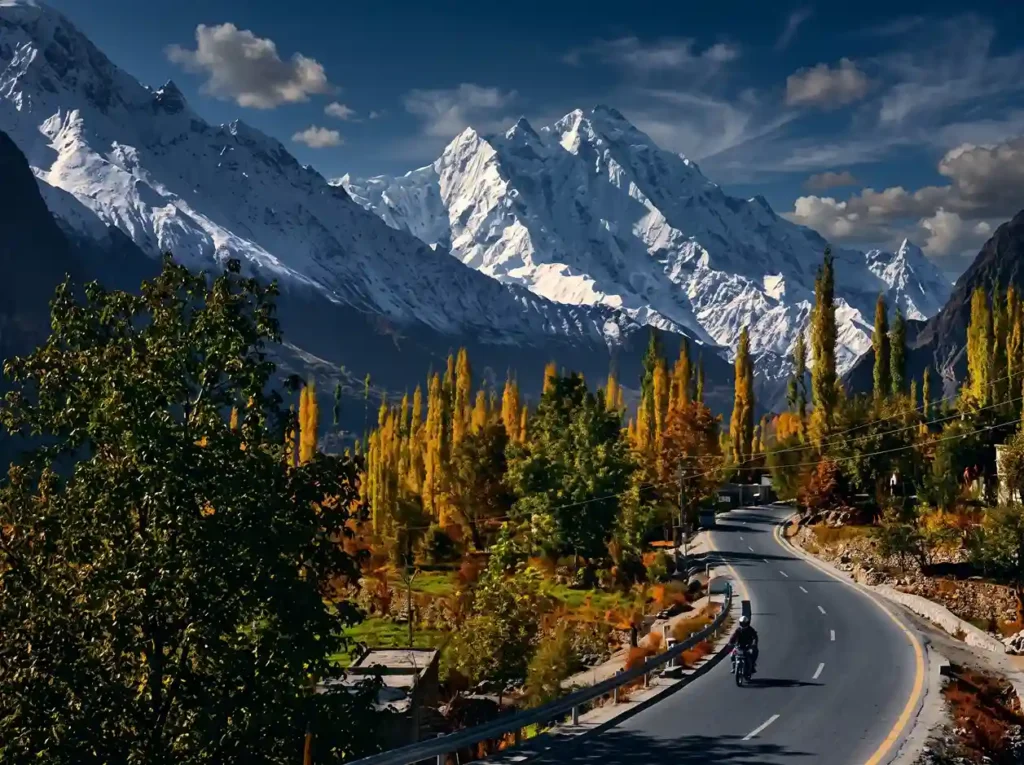
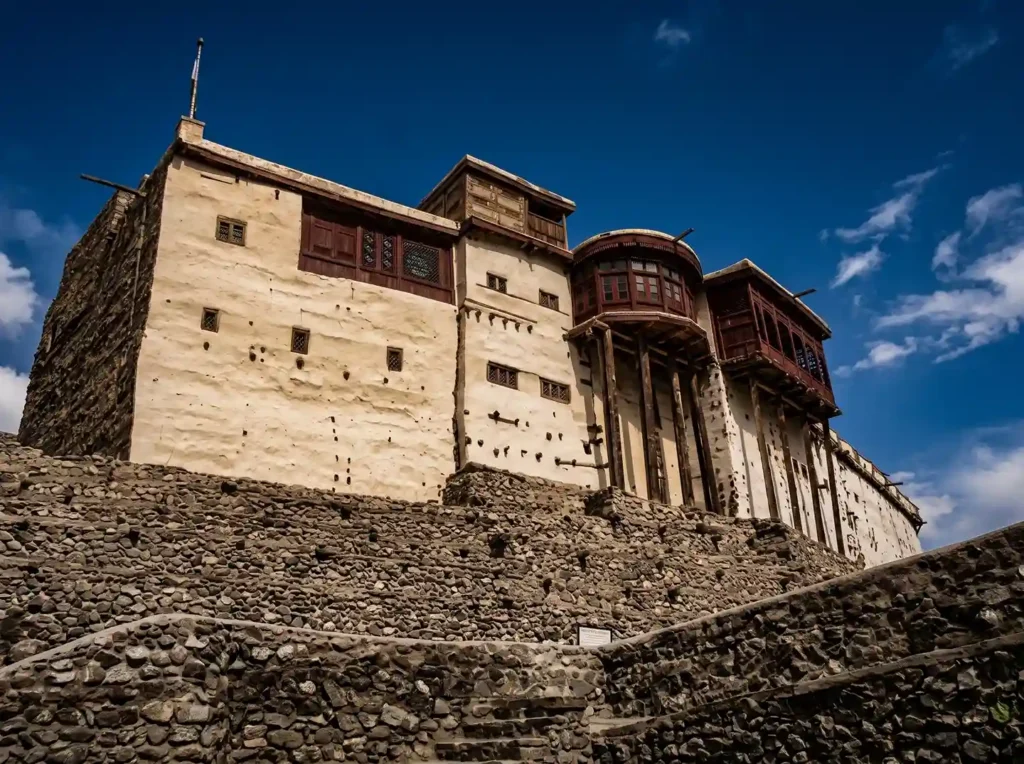
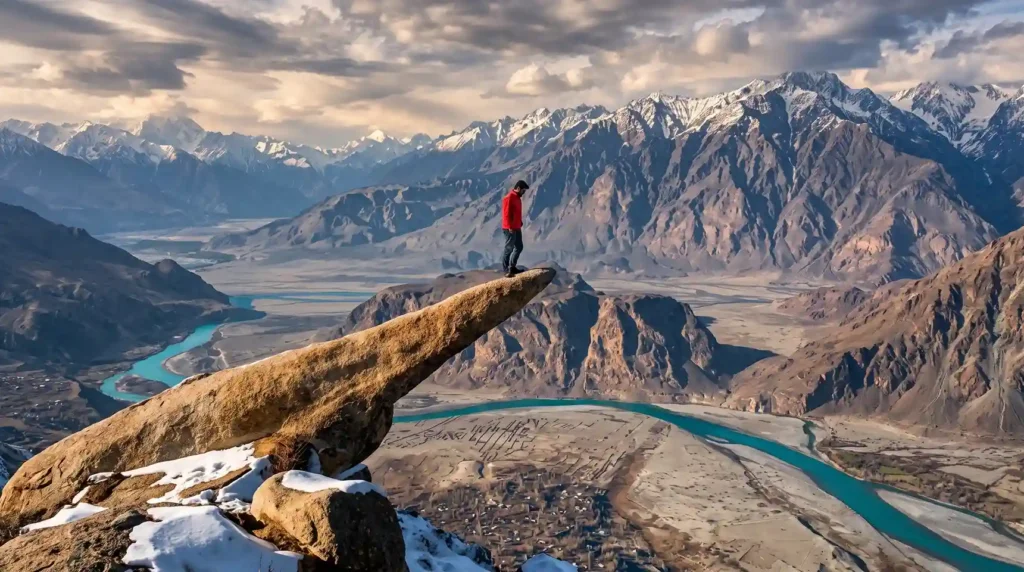
Skardu Fort, known locally as Kharpocho Fort, sits on a rocky hill on the eastern edge of Skardu town, right above the point where the Indus and Shigar rivers meet. It is one of the few sites in Skardu where a short climb gets you both a piece of Baltistan’s history and a full view of the valley in one visit. In the Balti language, the name is usually explained as “the king of forts,” and locals still refer to it that way when giving directions from the bazaar.
If you are building a Skardu itinerary and wondering whether to fit it in, the short answer is that most visitors can, and should, because it takes half a day or less and sits close to the town center rather than requiring a separate trip out of the valley. What follows covers its documented history, what you will actually see up there, how the climb feels, and the practical details you need before you go.
Quick Facts
| Detail | Information |
| Also known as | Kharpocho Fort, Kharphocho Fort |
| Location | Khardong hill, Skardu, Gilgit-Baltistan, Pakistan |
| Coordinates | Approximately 35.30°N, 75.64°E |
| Period of origin | Historically attributed to the late 15th or 16th century (see History section for why sources differ) |
| Attributed builder | Ali Sher Khan Anchan, Maqpon dynasty |
| Overlooks | Confluence of the Indus and Shigar rivers, Skardu town, the Rock of Skardu |
| Distance from Skardu town center | Close enough to walk to from most parts of town; a short drive plus a hill climb |
| Climb time | Roughly 15 to 30 minutes on foot, depending on fitness and pace |
| Terrain | Rocky, uneven, with a mix of natural steps and a built-up track |
| Entry fee | Reported to be a small ticketed amount at the gate; treat this as unconfirmed and check current rates locally (see Cost section) |
| Best time to visit | April to October |
| Suggested time needed | 45 minutes to 1.5 hours, including the climb |
| Difficulty | Moderate; not ideal for very young children or visitors with mobility limitations |
Skardu Fort History: What Is Actually Confirmed
This is where a lot of online writing about Kharpocho Fort gets sloppy, so it is worth being precise about what comes from where.
The Government of Gilgit-Baltistan’s Tourism, Sports, Culture, Archaeology and Museums Department describes Kharpocho Fort as an ancient structure built between 1490 and 1505 by Ali Sher Khan Anchan of the Maqpon dynasty. According to this account, once construction finished in 1505, the capital of the dynasty moved from Shigari Bala to Kharpocho, and the fort stayed the seat of Maqpon rule until the dynasty fell to Dogra forces in the 18th century. The same department’s records state that locals, with support from the Gilgit Scouts, retook the fort from Dogra control during the 1948 uprising against Dogra rule that followed the partition of the subcontinent.
The Department of Archaeology and Museums, Pakistan’s federal heritage body, lists the site as the Kharpocho Fort Complex and dates it to the 16th century CE, attributing it to the same ruler, Ali Sher Khan Anchan, whose reign it records as roughly 1560 to 1625. That reign window does not line up neatly with a fort supposedly finished in 1505, and this is exactly the kind of discrepancy the article should not paper over. Both agencies agree on who the fort is connected to and roughly which century it belongs to. They do not agree on the precise construction dates, and no independent excavation record resolves the gap. If you read a source that states an exact founding date with total confidence, treat that confidence as unearned.
The DOAM record adds detail that most travel blogs skip entirely. It notes that the fort standing on the hill today is not simply the original Maqpon-era structure. According to a stone inscription at the site, written in Persian and Hindi, the fort was rebuilt by the Dogra ruler Ranbir Singh, with a date corresponding to 1884 CE. The department’s survey describes this later construction as clearly different in style from the earlier fort, with round, battlemented towers that reflect Mughal-influenced military architecture rather than the older Balti building style. In plain terms: much of what you climb up to see is a 19th century Dogra-era rebuild sitting on the site of an earlier Maqpon fortification, not a single unbroken structure from the 1500s.
A separate detail worth knowing, because almost nothing online mentions it, involves the base of the hill. Heritage surveys record several graves at the foot of the fort, marked with flat marble slabs, belonging to ancestors of the present Raja of Skardu. On the hill’s northern side, at the bottom, there are also the remains of a small mud structure known locally as Mindoq Khar, next to a garden historically associated with a woman named Gul Khatoon, believed to have been connected to the fort’s royal household. None of this is dramatic, but it is the kind of physical, documented detail that separates an actual heritage site from a photo backdrop.
One more point worth flagging honestly: several travel articles claim the Mughal Empire tried and failed to capture Kharpocho Fort in the 17th century, sometimes calling it one of the few forts in the region never taken by the Mughals. This claim shows up repeatedly online, but it does not appear in either of the two official heritage sources reviewed for this guide. Treat it as a popular local story rather than a documented fact until a primary source confirms it.
Skardu Fort Location
Skardu Fort sits on Khardong hill, on the eastern side of Skardu town, positioned above the junction of the Indus and Shigar rivers and overlooking the large rock formation locally known as the Rock of Skardu. Its position was chosen for exactly this reason: from the top, whoever controlled the fort could see anyone approaching Skardu from either river valley, which is why it functioned as a military lookout rather than a purely residential palace.
Because the fort sits right at the edge of town rather than out in a separate valley, it is one of the easiest heritage sites in the area to combine with everyday errands, a visit to the bazaar, or a stop on the way to somewhere like the Skardu Desert (Katpana Cold Desert) or Satpara Lake. Most visitors reach the base of the hill by a short drive or a walk from wherever they are staying in town, then climb the rest of the way on foot.
What You Will Actually See at the Top
This is one of those sites where managing expectations matters. Kharpocho Fort is a genuine ruin, not a restored monument with information panels and a gift shop. Here is what things to see at Skardu Fort actually looks like in practice:
- The remaining walls and gatehouse. Sections of the outer wall and the old entrance still stand, giving a sense of scale even where the roofline is gone.
- The old mosque. Among the structures inside the fort compound, the mosque is generally the best preserved, and it gives a clearer picture of the layout than the more fragmented sections around it.
- Remnants of the watchtower. Heritage records note the remains of a watchtower at the top of the hill, consistent with the fort’s original role as a lookout point over the valley.
- The view itself. From the top, you get a wide, uninterrupted view of Skardu town, the confluence of the Indus and Shigar rivers, and the surrounding mountains. This is the main reason most visitors make the climb, and it holds up regardless of how much of the fort’s stonework has survived.
- The base-of-hill features. If you have time and interest, the graves near the foot of the hill and the Mindoq Khar structure on the northern side are worth a look, though they are easy to miss if you go straight up and back down.
What you will not find: interpretive signage, a ticket booth with printed information, or a formally managed visitor circuit. Several visitors describe an informal caretaker at the gate who has looked after the site for years and can share stories about the fort if you’re interested and have a little time. This is a nice, low-key part of the experience, not something to expect on a schedule.
Best Time to Visit Skardu Fort
| Season | Months | General Conditions | Recommended For |
| Spring | April to May | Mild days, trail dry but can be dusty; occasional rain | Photography, cooler climbing conditions |
| Summer | June to August | Warm, clear skies most days, trail fully dry | Best overall visibility, most reliable access |
| Early autumn | September to October | Cool, clear, fewer crowds than peak summer | Comfortable climbing temperatures, good light for photos |
| Winter | November to March | Cold, occasional snow or ice on the rocky trail | Generally not recommended; footing on the climb becomes unreliable |
Skardu itself sits at a high altitude, and the fort’s hilltop is significantly higher again than the valley floor. Heritage records put the elevated section of the fort at roughly 300 meters above the surrounding land at the base of the hill. That climb, combined with loose rock and uneven natural steps, is manageable in dry conditions but becomes genuinely risky when wet or icy. If you are visiting between November and March, ask your driver or the Ilyas Skardu Travels team about current trail conditions before committing to the climb.
Cost, Entry and Practical Details
This is one area where public information genuinely conflicts, and it would be dishonest to present a single confident number. Some sources describe a small, fixed entry ticket, with a lower rate for local visitors and a higher rate for foreign tourists. Others describe the visit as effectively free, with only a token or voluntary payment collected informally at the gate, and no formal ticket booth. Both descriptions show up in recent, reasonably credible sources, which suggests the actual arrangement may depend on who is managing the site at a given time, or may simply be inconsistently enforced.
What we can say with confidence: any fee involved is small by any standard, it is collected in person at the site rather than booked in advance, and it should not be a factor in whether you decide to visit. What we cannot confirm is an exact current amount or whether it is mandatory. Confirm current entry arrangements with your guide or with Ilyas Skardu Travels before you go, and carry a small amount of cash either way, since there is no card payment option at a hillside fort gate.
There is currently no independent operator selling advance tickets, guided tours, or transport specifically to Kharpocho Fort through major booking platforms, which is consistent with it being an open, informally managed heritage site rather than a commercially operated attraction.
Recommended Tourist Places in Skardu for Every Traveler
Explore our recommended Skardu tour packages, carefully designed for solo travelers, families, couples, and groups. Choose from flexible Budget, Standard, and Luxury options to match your travel style and budget.
| Tour(s) | Mode of Transport | Budget | Standard | Luxury |
|---|---|---|---|---|
| Kharpocho Fort Skardu: History, Location, Timing and Ticket Price | By Road | PKR 90,500 | PKR 115,000 | PKR 194,000 |
| Shigar Valley Skardu: Complete Travel Guide, Attractions & Things to Do | By Air | PKR 100,500 | PKR 140,500 | PKR 220,000 |
| Blind Lake Skardu Tour: A Half-Day Trip Through Shigar Valley | By Road | PKR 9,500 | PKR 12,500 | PKR 15,000 |
| Baltit Fort Hunza: Karimabad’s Historic Landmark | By Road | PKR 20,000 | PKR 30,000 | PKR 40,000 |
| Organic Village Skardu Tour: Walk to Nangsoq | By Air | PKR 115,000 | PKR 136,000 | PKR 25,000 |
| Attabad Lake Hunza: Complete Travel Guide | By Air | PKR 130,000 | PKR 150,000 | PKR 235,000 |
| Skardu Autumn Tour Package 2026: Golden Valleys, Lakes and Forts | By Road | PKR 168,000 | PKR 250,000 | PKR 390,000 |
Getting There
Reaching Skardu. Most travelers arrive either by a roughly one-hour flight from Islamabad (subject to weather delays and occasional cancellations, since Skardu Airport operates under visual flight conditions) or by road via the Karakoram Highway, a journey that typically takes well over half a day depending on route, season, and road conditions. If you are combining a fort visit with a wider Gilgit-Baltistan trip, our Skardu Travel Guide covers this in more depth, and Skardu Tour Packages can handle transport and timing for you.
Reaching the fort from town. From most parts of Skardu, the base of Khardrong hill is a short drive away. From there, the climb itself is on foot, following the improved track and stone steps that lead up from the base to the fort gate. There is no vehicle access up the hill itself.
Difficulty and Fitness Requirements
The climb is best described as moderate rather than easy or difficult. Expect 15 to 30 minutes of uphill walking on a mix of built steps and natural rocky ground, depending on your pace and how many stops you take for photos or to catch your breath at altitude. Reasonably fit adults, teenagers, and older children generally manage it without special preparation. It is not a good fit for very young children who need to be carried the whole way, for visitors with significant mobility limitations, or for anyone with a knee or balance condition that makes uneven rocky terrain risky. Sturdy, closed-toe shoes with grip make a real difference here, since parts of the track are loose gravel over rock.
What to Bring
- Sturdy walking shoes with good grip, not sandals or smooth-soled shoes
- Water, since there is no shop or refreshment point on the way up
- Sun protection (hat, sunscreen) for the exposed, largely shade-free climb
- A light jacket if visiting in the early morning or evening, since temperatures shift quickly at this elevation
- Small cash for any entry fee or informal payment at the gate
- A camera or phone with a wide lens, since the confluence view rewards a wide shot
Important Travel Information
Gilgit-Baltistan is generally treated as a standard part of Pakistan for domestic travel, but foreign nationals should carry valid identification or passport copies with them when visiting heritage and border-adjacent regions, and it is worth confirming current entry and documentation requirements with your operator or Pakistan’s relevant tourism authority before travel, since rules can be updated. Mobile network coverage in Skardu town is generally reliable, though it can weaken on the hill itself depending on your provider. There are no restrooms or facilities at the fort site, so plan accordingly before you start the climb. As with any hillside site with loose rock, avoid climbing after dark, and use extra caution near the unguarded sections of wall at the top.
Booking Information
Kharpocho Fort itself does not need to be pre-booked, since it is an open heritage site rather than a ticketed tour product. Where Ilyas Skardu Travels and Tours can genuinely help is in building it into a properly timed day, arranging a driver who knows the current trail condition, and pairing it with nearby sights so you are not making separate trips across town. If you would like the fort included as a stop on a custom day plan, get in touch with our team and we can work it into your dates.
Related Places to Combine with Your Visit
Because the fort sits close to Skardu town, it pairs naturally with a half-day or full-day loop rather than needing its own dedicated trip:
- Satpara Lake, a short drive from town, good for a relaxed second stop after the climb
- Skardu Desert / Katpana Cold Desert, one of the more unusual landscapes in the valley and easy to combine on the same day
- Manthoka Waterfall, for travelers with a bit more time who want to head further out
- Shigar Valley, for those interested in Baltistan’s other historic forts and palaces
- Deosai National Park, for a longer trip that goes well beyond a single day
- Skardu Hotels / Accommodation Guide, if you are still finalizing where to stay while exploring these sites