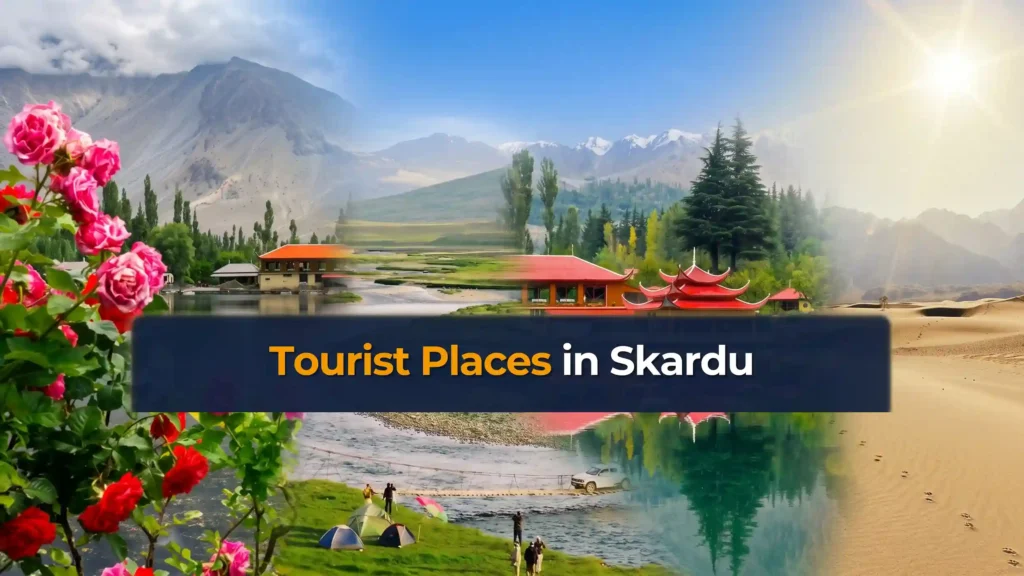
Skardu sits where the Indus and Shigar rivers meet, ringed by the Karakoram range, at an elevation of roughly 2,200 to 2,500 meters depending on exactly where in the valley you’re standing. It is the main town of Baltistan and the usual starting point for almost every trip into this part of Gilgit-Baltistan, whether that trip ends at a lakeside picnic an hour from town or at a K2 base camp trek three weeks long. If you’re trying to work out which tourist places in Skardu are worth your time, the honest answer is that the city itself holds a handful of attractions you can cover in two or three days, while the more striking scenery, the Deosai plateau, the cold deserts, Shigar and Khaplu, sits a drive away in the wider Baltistan region.
This guide walks through both. It separates what’s actually inside Skardu city from what’s a day trip or overnight away, gives distances and drive times as they’re generally reported (flagging it clearly wherever sources disagree, which happens more often than you’d expect on mountain roads), and covers the practical planning questions that come up once you start looking at an actual itinerary.
Getting to Tourist Places in Skardu
Most visitors reach Skardu one of two ways. The faster option is a domestic flight from Islamabad, which takes around an hour and is genuinely one of the more scenic short flights available anywhere, weather permitting. That last part matters: Skardu Airport sits in a mountain valley and operates largely under visual flight rules, so flights get delayed or cancelled when cloud cover or wind isn’t cooperating, more often in spring than in peak summer. Anyone flying in and out on a tight schedule should build at least one buffer day into the trip on each end, because a cancelled flight usually means waiting for the next available seat rather than an immediate alternative.
The road option runs via the Karakoram Highway, either through Besham and Chilas year-round, or via Naran and the Babusar Pass in the warmer months (the pass itself closes with the first heavy snow and doesn’t reopen until late spring). Reported drive times vary a fair amount depending on the source and on how many stops you make; expect somewhere in the range of 18 to 22 hours of road travel from Islamabad under normal conditions, which most travelers split across two days with an overnight in Chilas or Gilgit rather than attempting it in one push. If you already have flights booked and want a backup plan, ask your operator to keep a road option on standby for the same reason airlines themselves recommend it: cancellations happen.
Quick Facts: Skardu at a Glance
| Detail | Information |
| Region | Baltistan Division, Gilgit-Baltistan, Pakistan |
| Elevation of Skardu town | Approximately 2,200–2,500 meters (7,300–8,200 ft.) |
| Nearest airport | Skardu International Airport (KDU) |
| Flight time from Islamabad | Roughly 55 minutes to 1 hour 15 minutes (weather-dependent) |
| Road distance from Islamabad | Approximately 630–700 km depending on route |
| Road travel time from Islamabad | A long full day at minimum; often spread over two days with an overnight stop |
| Main tourist season | May to October, with July–August as peak |
| Deosai National Park access | Mid-June to mid-October only (varies year to year with snowfall) |
| Language | Balti (local), Urdu, English understood in tourism settings |
| Currency | Pakistani Rupee (PKR) |
Prices, exact opening dates for Deosai, and road conditions change from year to year and even week to week, so treat the table above as a planning baseline and confirm current details with your operator closer to your travel dates.
Kharpocho Fort (Skardu Fort)
Kharpocho, meaning “King of Forts” in Balti, is the closest thing Skardu has to a single defining landmark. It was built in the late 16th century under the Maqpon dynasty ruler Ali Sher Khan Anchan, on a rocky spur directly above the point where the Indus and Shigar rivers meet, and it functioned as a military lookout for centuries because of exactly that position. Getting to the top means a genuine climb rather than a stroll: a steep, switchbacking path with loose rock in tourist places in Skardu and a drop on one side, generally taking 30 to 45 minutes on foot from the base near the old town and polo ground. It isn’t difficult so much as unrelenting, and anyone with knee problems or limited mobility may prefer to view the fort from the polo ground area below, which itself gives a good angle on the structure.
What you’re rewarded with at the top is the view, not the ruins themselves; the fort’s walls are weathered and largely unrestored, but the panorama over Skardu town, the river confluence, and the Katpana Desert beyond is the actual point of the climb. Early morning or late afternoon light works best for photography, both because the heat is more manageable and because the low sun picks out the terracing and river channels below. During the 1947–48 conflict that followed Partition, control of the fort was contested as part of the wider fighting for Baltistan, a fact locals still bring up when guiding visitors through the site.
Manthal Buddha Rock
A short drive from town, off the road that leads toward Satpara Lake, sits a large granite boulder carved with a seated Buddha figure surrounded by smaller bodhisattva attendants. Most sources date the carving to roughly the 8th century, a period when Buddhism was the dominant faith across the upper Indus valley, before Islam arrived in the region in the 14th century. It’s a genuinely quiet site, easy to combine with a Satpara Lake visit since it sits just off the same road, and it rewards a few unhurried minutes looking at the detail rather than a quick photo stop. The carving remained largely unknown outside the region until the early 1900s, when a European traveler documented it and brought it to wider attention; local caretakers now collect a modest entrance fee, currently reported around Rs. 500, though you should confirm the current rate before visiting since entry fees at heritage sites in the region change without much notice.
Satpara Lake
Satpara Lake is the easiest “proper” lake to reach from Skardu, roughly a 20 to 25-minute drive along the road that eventually continues on toward Deosai. It sits at an elevation of around 2,600 meters, spread across an area reported at somewhere between 2.5 and 4 square kilometers depending on the source (the range likely reflects seasonal water level and where exactly the shoreline is measured), and it doubles as the main water supply for Skardu town via the Satpara Dam. There’s a small island near the middle of the lake that boat operators will take you out to, along with straightforward boating and some trout fishing for anyone who wants to try, gear rentable at the lakeside. The water carries a genuine turquoise cast on a clear day, less so under overcast skies, so if photography is the priority it’s worth checking the forecast before committing to a visit window.
Because it sits directly on the Deosai road, Satpara Lake works well as a stop on the way to or from the plateau rather than a separate trip, and most Skardu itineraries treat it that way.
Shangrila Resort and Lower Kachura Lake
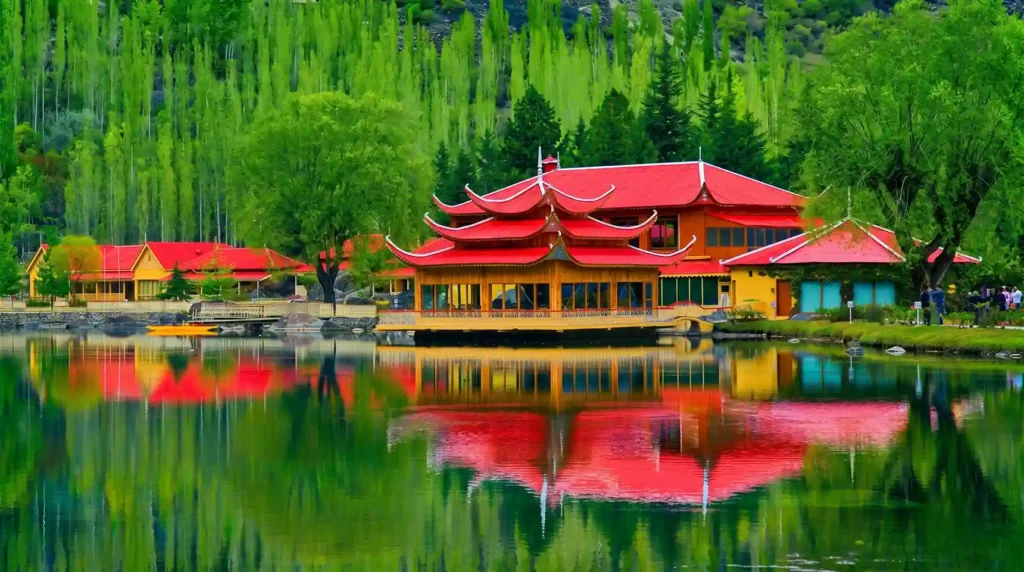
Lower Kachura Lake, universally known by the name of the resort built around it, Shangrila, is the heart-shaped lake that shows up in most Skardu photography you’ll have already seen before arriving. It sits roughly 25 to 30 km from Skardu town, a drive most sources put at somewhere between 25 and 40 minutes depending on traffic through Kachura village; the resort itself opened in 1983 as the first tourist resort built anywhere in the northern areas, and its restaurant built inside the fuselage of a decommissioned aircraft remains one of the more talked-about details of any Skardu trip. The lake sits at around 2,500 meters, ringed by orchards and pine slopes, and you don’t need to be staying at the resort to walk the grounds, take a short boat ride, or eat at one of the cafés, though entry arrangements can change so it’s worth checking current access policy with your operator.
Just above Shangrila, a roughly 30-minute walk up through pine forest (or a short drive, for those who’d rather skip the climb) brings you to Upper Kachura Lake, a deeper, quieter, and considerably less developed lake that shares the slope but almost none of the infrastructure. Where Lower Kachura is gardens, cottages, and a working resort, Upper Kachura is forest silence and water that shifts between green and blue depending on the light. Most visitors do both in a single half-day trip: an hour or two at Shangrila, then the walk up to Upper Kachura before the afternoon light changes.
Recommended Tourist Places in Skardu for Every Traveler
Explore our recommended Skardu tour packages, carefully designed for solo travelers, families, couples, and groups. Choose from flexible Budget, Standard, and Luxury options to match your travel style and budget.
| Tour(s) | Mode of Transport | Budget | Standard | Luxury |
|---|---|---|---|---|
| Kharpocho Fort Skardu: History, Location, Timing and Ticket Price | By Road | PKR 90,500 | PKR 115,000 | PKR 194,000 |
| Shigar Valley Skardu: Complete Travel Guide, Attractions & Things to Do | By Air | PKR 100,500 | PKR 140,500 | PKR 220,000 |
| Blind Lake Skardu Tour: A Half-Day Trip Through Shigar Valley | By Road | PKR 9,500 | PKR 12,500 | PKR 15,000 |
| Baltit Fort Hunza: Karimabad’s Historic Landmark | By Road | PKR 20,000 | PKR 30,000 | PKR 40,000 |
| Organic Village Skardu Tour: Walk to Nangsoq | By Air | PKR 115,000 | PKR 136,000 | PKR 25,000 |
| Attabad Lake Hunza: Complete Travel Guide | By Air | PKR 130,000 | PKR 150,000 | PKR 235,000 |
| Manthoka Waterfall Skardu: A Complete Guide | By Road | PKR 168,000 | PKR 250,000 | PKR 390,000 |
Katpana Cold Desert and Sarfaranga Cold Desert
Skardu has two cold deserts, and travelers mix them up constantly, which is understandable since both are high-altitude sand dune fields sitting near the Indus at an elevation where you’d never expect to find a desert at all.
Katpana Desert, also called Biama Nakpo locally, sits closer to town, around 15 to 20 minutes’ drive, at an elevation of roughly 2,226 meters. It’s the calmer of the two: rolling white dunes that pick up a dusting of snow in winter, a striking and genuinely unusual combination that draws photographers specifically for that reason. There’s little infrastructure and few crowds outside the winter snow window, which makes it one of the better stargazing spots near Skardu given how dark the skies get once the sun is down.
Sarfaranga Desert sits a little farther out, in Shigar district, roughly 20 to 30 minutes from Skardu depending on the exact route taken. It’s the more adventure-oriented of the two, with a wider open track used for quad biking, jeep safaris, and the annual Sarfaranga Cold Desert Jeep Rally, an event that’s grown into one of the larger motorsport gatherings in the country. Dates for the rally move around (it has run in both August and October in recent years), so if you specifically want to catch or specifically want to avoid the crowds it brings, check the current year’s schedule before booking your dates.
If you only have time for one: Katpana suits a quieter visit and better photography of the snow-on-sand contrast in winter; Sarfaranga suits anyone who wants to actually drive or ride across the dunes.
Deosai National Park
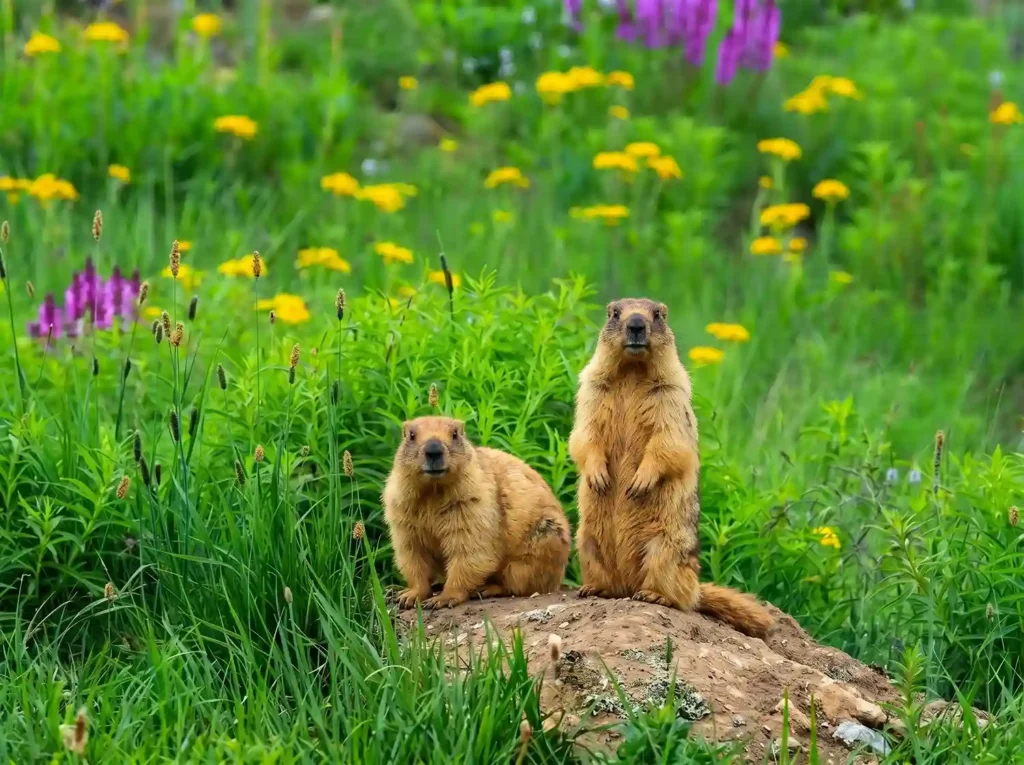
Deosai is the single biggest reason many travelers extend a Skardu trip by an extra day. It’s a high alpine plateau, regularly described as the second-highest plateau in the world after Tibet’s Changtang, sitting at an average elevation of around 4,114 meters and covering roughly 3,000 square kilometers of open grassland, snowmelt streams, and scattered lakes. It was declared a national park in 1993 specifically to protect the Himalayan brown bear population, which had fallen to a few dozen animals at the time and has recovered substantially since, alongside golden marmots, Himalayan ibex, red fox, and birds of prey including golden eagles.
Access is strictly seasonal.
The road from Skardu typically clears by mid-June and closes again with the first serious autumn snowfall, usually around mid-October, though the exact dates shift year to year and should be confirmed close to your travel date rather than assumed. Outside that window, the plateau is simply not reachable. Within the season, July and August bring the plateau’s wildflowers to full bloom and are the most reliable months for bear sightings, while September offers a quieter, golden-brown landscape with fewer other visitors.
The drive from Skardu runs via Sadpara Lake and covers rough, unpaved terrain for most of its length, so a 4×4 is not optional. Reported distances to specific points inside the park vary noticeably between sources, generally because they measure to different destinations: the plateau’s entrance around Bara Pani sits roughly 30 to 40 km from Skardu, while Sheosar Lake, the park’s best-known lake at roughly 4,142 meters and among the highest-altitude lakes anywhere, sits further in, with total one-way travel time commonly reported between two and three hours depending on road conditions and how far into the plateau you go. Some itineraries continue all the way across Deosai to Astore on the far side, a genuinely different and considerably longer route that isn’t a there-and-back day trip.
Weather on the plateau turns quickly even in midsummer, and temperatures at night drop well below what the daytime warmth suggests, so warm layers are essential even for a single-day visit, not just for anyone camping overnight.
Shigar Valley and Shigar Fort
Shigar sits a little over an hour from Skardu by road, roughly 30 km, and functions as a distinct destination in its own right rather than an extension of Skardu city; it was in fact its own district before 2015. The valley is the main overland gateway to the Baltoro Glacier and, eventually, K2 base camp, so it carries a mountaineering pedigree that Skardu’s other attractions don’t, alongside a much gentler, greener character close to the river: terraced fields, orchards of apricots, walnuts, and pears, and villages that still run largely on agriculture.
The centerpiece is Shigar Fort, also called Fong Khar or “the Palace on the Rock,” a roughly 400-year-old fort and palace built for the Raja of Shigar under the Amacha dynasty, restored by the Aga Khan Trust for Culture and now operated as a heritage hotel and small museum by Serena Hotels. You don’t need to be a guest to visit for a couple of hours and take in the architecture, walnut wood floors, and antique furnishings, though an entrance fee applies for non-guests (reported in the range of Rs. 1,000 for local visitors and higher for foreign visitors; confirm the current figure before you go). Nearby, the Amburiq Mosque, one of the oldest in Baltistan, is a short stop worth adding if you’re already in the valley.
Basho Valley (Sultanabad Meadows)
Basho, also known locally as Sultanabad Meadows, sits within Roundu tehsil and is one of the better spots near Skardu for anyone who wants pine forest and open meadow rather than desert or lake scenery. It’s a genuine outlier when it comes to reported distances: some sources quote around 20 km and under an hour, others put it closer to 40 to 45 km and two and a half to three hours. The gap makes sense once you understand where each figure stops measuring. The first stretch out of Skardu, to the Basho Bridge, runs on a smooth paved highway that any vehicle can handle. Past the bridge, the road turns into a rough jeep track climbing into the meadows themselves, where most travelers actually camp, and that second stretch is what accounts for the extra distance and time in the higher estimates. If a source quotes a short, easy trip to Basho, it’s almost certainly describing only the drive to the bridge, not the meadows.
Basho suits an overnight camping trip better than a rushed day visit, given the extra time the jeep track adds, though a shorter visit to the lower valley and bridge area is a reasonable half-day add-on for anyone tight on time.
Manthoka Waterfall
Manthoka sits in Kharmang Valley, and here again, reported distances and drive times diverge more than usual, ranging anywhere from roughly 60 km to 120 km and one and a half to three and a half hours depending on the source. Some of that spread likely comes down to route choice and where within Skardu the measurement starts; either way, it’s a genuine half-day-plus commitment rather than a quick stop, so plan it as a dedicated excursion, often combined with Khaplu given the general direction of travel. The waterfall itself drops around 180 feet and is easily viewed from a short walk with parking nearby, and there’s a trout farm and small restaurant at the site that serves fresh trout, a local specialty worth trying while you’re there. The site gets genuinely busy in peak season, so an early start helps if a quieter visit matters to you.
Khaplu Valley
Khaplu sits at the far eastern edge of what most Skardu itineraries reach, roughly 103 to 110 km away along the Shyok River, generally a two to three-hour drive on a road that’s paved for most of its length with rougher sections near river crossings. It was historically the second-largest kingdom of the old Yabgo dynasty in Baltistan, and that history is still visible in Khaplu Palace (Yabgo Khar), a restored royal residence now run as a Serena heritage hotel and open to day visitors for a fee (again, confirm the current rate, reported in past listings around Rs. 1,000 to 2,000 depending on nationality). The Chaqchan Mosque, dating back roughly 700 years and attributed to the Sufi missionary Mir Sayyid Ali Hamadani, blends Tibetan, Persian, and Mughal architectural influences in a way that’s unusual even by the standards of the region’s older mosques.
Khaplu also functions as the launch point for the Hushe Valley, roughly another 60 km north, which leads toward the base camps for K6, K7, and Masherbrum, though that’s a trip for travelers specifically interested in trekking rather than a standard sightseeing add-on. Most general visitors treat Khaplu itself as a comfortable one to two-night extension: drive out, see the palace and mosque, overnight, and return, rather than a rushed day trip given the distance involved.
Chunda Valley
Chunda sits close to Skardu, near where the Indus and Shigar rivers meet, at an elevation similar to the town itself, around 2,500 meters. It’s a much lower-key destination than the others on this list, worth knowing about mainly for its blossom season: in spring, the valley’s apricot and cherry orchards flower in pink and white across the terraced slopes, which makes it one of the better short, easy add-ons for anyone visiting Skardu in April rather than the usual June to September window. Outside blossom season it’s a pleasant but comparatively ordinary agricultural valley, so time your visit around late March to April specifically if blossoms are the draw, and check with a local contact closer to the date since bloom timing shifts from year to year with the weather.
Best Time to Visit Skardu’s Tourist Places
| Season | Months | What’s Open and What to Expect |
| Spring | March–May | Blossom season in Chunda and Shigar valleys; lower-elevation sites accessible; Deosai and high passes still closed; weather can be unstable, more flight cancellations |
| Summer | June–September | Peak season; Deosai open from roughly mid-June; all major sites accessible; warmest and busiest period, especially July–August |
| Autumn | September–mid-October | Quieter than summer, generally clear and stable weather; Deosai closes around mid-October; good light for photography |
| Winter | November–February | Deosai and Babusar Pass closed; Katpana Desert gets its snow-on-sand look; cold but generally clear; fewer tourists, some hotels and services scale back |
Given how much these dates shift year to year with snowfall and road maintenance, always confirm current access for Deosai and any pass-dependent route with your operator shortly before departure rather than relying on a fixed calendar.
Practical Travel Information
Fitness and difficulty:
Most of Skardu city’s own attractions (Kharpocho Fort’s climb aside) require no special fitness. Deosai, Basho’s meadow section, and Manthoka involve rough roads rather than physical exertion, so the main consideration is tolerance for long jeep rides rather than hiking ability, unless you’re adding an actual trek toward Hushe or Baltoro.
Altitude:
Skardu town itself sits at a moderate altitude that rarely causes problems, but Deosai’s roughly 4,100 meters and Sheosar Lake’s 4,142 meters are high enough that some visitors notice mild effects such as headache or shortness of breath, particularly if arriving there soon after flying in from lower altitude. Staying hydrated and avoiding overexertion on the day helps; anyone with a known heart or lung condition should check with a doctor before planning a Deosai visit.
Permits and documentation:
Requirements for foreign travelers in Gilgit-Baltistan have relaxed considerably in recent years, and most standard tourist routes around Skardu, Shigar, and Khaplu do not require a special permit for either domestic or international visitors. Some areas closer to sensitive border zones may still require additional documentation or advance notice. Rules in this category change without much public notice, so confirm current requirements for your specific nationality and itinerary with your tour operator or the local district administration before travel, rather than relying on older blog posts.
Connectivity:
Mobile signal is reasonably reliable in Skardu town and along the main Shigar and Khaplu roads, and drops out entirely in stretches of Deosai, Basho’s upper meadows, and parts of the Manthoka route. Download offline maps and let someone know your day’s plan before heading into any of these areas.
What to carry:
Warm layers even in summer, given the swing between daytime sun and evening cold at altitude; sturdy, closed footwear for Kharpocho Fort and Manthoka’s uneven paths; sun protection, since UV exposure is stronger at this elevation than the temperature suggests; cash, since ATMs and card payment are unreliable outside Skardu’s main bazaar; and a basic first aid kit for longer day trips like Deosai and Khaplu where medical facilities are limited.
What to carry:
A first-time visitor with four or five days will generally get the most out of Skardu by grouping attractions geographically rather than crisscrossing back and forth: one day for the city sites (Kharpocho Fort, Manthal Buddha Rock, Katpana Desert), one day for Satpara Lake and Shangrila or Upper Kachura, one full day for Deosai if the season allows it, and a further day or two for either Shigar or a Khaplu overnight, depending on which side of the region appeals more. Trying to fit Deosai, Khaplu, and Manthoka into the same short trip tends to leave every stop feeling rushed, given the drive times involved, so it’s worth being realistic about how much ground a single trip can cover.
If you’d rather not work out the logistics yourself, Ilyas Skardu Travels and Tours puts together Skardu tour packages built around exactly this kind of grouping, with Skardu jeep and 4×4 rental arranged for the rougher routes like Deosai and Basho.
Related Tours and Destinations
- Explore the wider region with our Hunza Tour Package, often paired with a Skardu trip for travelers covering both valleys
- Add the plateau properly with a dedicated Deosai Tour rather than squeezing it into a single rushed day
- See the region in its spring colors with our Autumn Tour in Hunza for a different seasonal experience
- Planning around the falls specifically: our dedicated Manthoka Waterfall Skardu page covers logistics in more depth
- Traveling as a couple: our Honeymoon Tour Packages lean into Khaplu and Shangrila’s quieter side
- Traveling with family: our Family Tour Packages are built around easier, shorter driving days
Booking Information
Availability for jeeps, guides, and heritage hotel rooms at Shigar and Khaplu tightens up considerably during July and August, so book at least a few weeks ahead if you’re traveling in peak season. Contact Ilyas Skardu Travels and Tours to check current availability for your dates, or ask about a customized itinerary if you want to prioritize a specific mix of these tourist places in skardu rather than following a fixed route.
Tour Highlights
- Kharpocho Fort ki climb aur Indus-Shigar river confluence ka panoramic view
- Manthal Buddha Rock – 8th century ki carved Buddha statue
- Satpara Lake par boating aur turquoise water views
- Shangrila Resort (Lower Kachura Lake) aur Upper Kachura Lake trek
- Katpana Cold Desert mein sunset aur stargazing
- Deosai National Park – Himalayan brown bear habitat aur Sheosar Lake
- Shigar Fort (Palace on the Rock) aur Amburiq Mosque visit
- 4x4 jeep experience on Deosai aur Basho routes
Included
- Airport/hotel pick and drop
- Accommodation (hotel/guesthouse as per package)
- 4x4 jeep for Deosai and rough terrain routes
- Local guide
- Entry fees to major sites (Kharpocho Fort, Manthal Rock, Shigar Fort)
- Breakfast daily
Excluded
- Flight/road transport to and from Islamabad
- Lunch and dinner (unless specified in package)
- Personal expenses (shopping, tips, extra activities like boating/quad biking)
- Travel insurance
- Any permit fee for restricted zones (if applicable)
Gallery