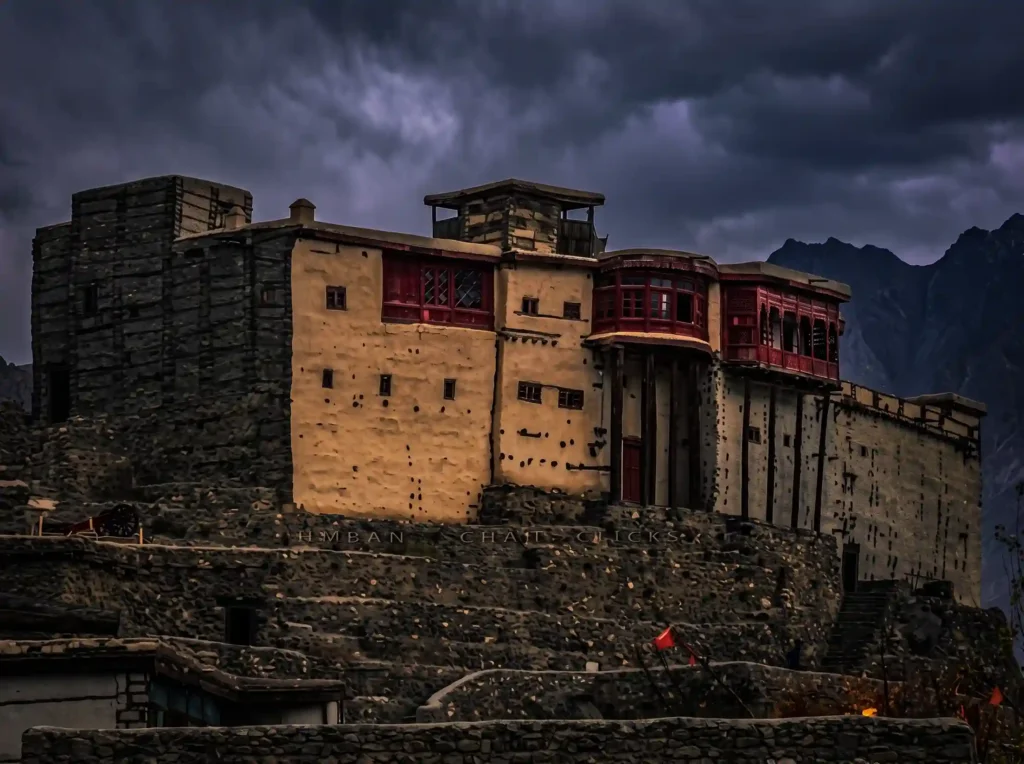
Kharpocho Fort Skardu sits on a rocky outcrop right above the town, at the point where the Indus and Shigar rivers meet. Locals call it Kharpocho, which means “King of Forts” in Balti, and most people just walk up from town, spend twenty minutes wandering the old walls, and come back down having seen the whole Skardu valley laid out below them. It isn’t a restored showpiece with ticket booths and gift shops. It’s a genuine ruin, still standing on the hill where a Balti king put it more than four hundred years ago, and that rough, unpolished quality is a big part of why people remember it.
This guide covers what the fort actually is, how old it really is, how high up it sits, what it costs to get in, when to go, and how to plan the visit around the rest of a Skardu trip. If you’re building a wider itinerary around Skardu, our Skardu Tour Packages and Skardu Travel Guide cover how the fort fits alongside the valley’s other stops.
Where Kharpocho Fort Skardu Is Located
Kharpocho Fort Skardu location is about as central as a historic site can be. The fort stands on a small, steep hill on the eastern edge of Skardu town, close enough to the main bazaar that most visitors walk there rather than drive. It looks down on the confluence where the Indus River, coming down from Ladakh, meets the Shigar River flowing in from the north. That confluence is the whole reason the fort exists here and nowhere else. Whoever controlled this hill controlled the approach to the entire Skardu valley, since both rivers and the routes that follow them pass directly beneath it.
If you’re coming from Yadgar Chowk or the main market area, the fort is a short walk away, followed by the climb up the hill itself. Coming from the airport or from a hotel further out, it’s a quick drive to the base of the hill, then the same walk up. The Skardu Rock, a separate large boulder formation near the confluence, sits close by and is often photographed together with the fort in the same frame.
Quick Facts About Kharpocho Fort
| Detail | Information |
| Name | Kharpocho Fort (also called Skardu Fort) |
| Meaning | “King of Forts” in the Balti language |
| Location | Skardu city, Gilgit-Baltistan, Pakistan, above the Indus-Shigar river confluence |
| Built | Late 16th century, under Raja Ali Sher Khan Anchan |
| Height above the city | Roughly 40 meters (about 130 feet) above Skardu town on a rocky hill |
| Hike to the top | About 15 to 30 minutes on foot, depending on pace and fitness |
| Entry | A small entry fee is generally charged; amount and enforcement vary, so confirm locally before visiting |
| Timing | Generally accessible during daylight hours; no strict, consistently published opening and closing time |
| Best season | April to October |
| Nearest airport | Skardu Airport (KDU), a short drive from the fort |
| Distance from Katpana Desert | Around 4 to 5 km |
Prices, entry rules, and timings at heritage sites in Gilgit-Baltistan can shift with the season and with who is managing the site that year, so treat the figures above as a starting point and confirm current details with a local guide or with our team before you travel.
Recommended Skardu Tour Packages for Every Traveler
Explore our recommended Skardu tour packages, carefully designed for solo travelers, families, couples, and groups. Choose from flexible Budget, Standard, and Luxury options to match your travel style and budget.
| Tour(s) | Mode of Transport | Budget | Standard | Luxury |
|---|---|---|---|---|
| Autumn in Hunza: A Complete Tour Guide | By Road | PKR 90,500 | PKR 115,000 | PKR 194,000 |
| Skardu Desert: A Complete Guide to Pakistan’s Highest Cold Desert | By Air | PKR 100,500 | PKR 140,500 | PKR 220,000 |
| Blind Lake Skardu Tour: A Half-Day Trip Through Shigar Valley | By Road | PKR 9,500 | PKR 12,500 | PKR 15,000 |
| Baltit Fort Hunza: Karimabad’s Historic Landmark | By Road | PKR 20,000 | PKR 30,000 | PKR 40,000 |
| Organic Village Skardu Tour: Walk to Nangsoq | By Air | PKR 115,000 | PKR 136,000 | PKR 25,000 |
| Attabad Lake Hunza: Complete Travel Guide | By Air | PKR 130,000 | PKR 150,000 | PKR 235,000 |
| Manthoka Waterfall Skardu: A Complete Guide | By Road | PKR 168,000 | PKR 250,000 | PKR 390,000 |
The History of Kharpocho Fort
Kharpocho Fort history goes back to the late 1500s, when Raja Ali Sher Khan Anchan, the ruler who unified Baltistan under one kingdom for the first time, built the earliest structure on this hill. He extended his territory as far as Ladakh during his reign, and the fort became the seat of the Maqpon dynasty that ruled Baltistan for generations afterward. A palace known as Mindoq Khar, built for his Ladakhi queen, once stood right beside the fort, which tells you this wasn’t purely a military outpost. Rulers actually lived here, alongside their families, for long stretches of the dynasty’s history.
The fort stayed in Maqpon hands until the 19th century, when the Dogra general Zorawar Singh invaded Baltistan in 1840 as part of a wider campaign to bring the region under Jammu and Kashmir’s control. He took the fort and largely destroyed it, then built a separate fort on level ground nearby rather than rebuilding on the hill. That’s one of the reasons what stands today is a ruin rather than a fully intact palace complex; a lot of the damage dates from that 1840 campaign, not simple age.
The fort’s more recent history sits inside a much bigger regional story. During the fighting that followed the 1947 partition of British India, the area around Skardu, including this hill, became a contested position between Pakistan-aligned forces and Jammu and Kashmir state forces. Accounts of exactly how the siege played out vary between sources, and some of the more dramatic details circulating online aren’t easy to verify against a single reliable record, so it’s fair to say the fort was caught up in that conflict without pinning down every specific date or figure as certain. What’s well documented is the outcome: Skardu became part of Pakistan-administered territory, and the fort has stood as a civilian heritage site ever since, not an active military position.
There’s a discrepancy worth flagging here. A few tourism blogs describe the fort as being over a thousand years old, while the more consistently cited version, including the account on Wikipedia and most detailed historical write-ups, places its construction at the end of the 16th century under Ali Sher Khan Anchan. The older date most likely comes from confusing the fort itself with the much longer history of settlement and rule in the Skardu valley generally. When the two accounts conflict this directly, it’s worth going with the version that’s cross-referenced across multiple independent sources, which is the late 16th century construction date.
Kharpocho Fort Height and What You’ll See on the Climb
Kharpocho Fort height is a detail that gets exaggerated online more than almost anything else about the site. Some pages quote figures in the hundreds or even thousands of meters above the city, which would put the fort somewhere near the summit ridgelines visible from Skardu, and that’s simply not what you find on the ground. Multiple independent, locally sourced accounts describe the fort as sitting roughly 40 meters above the town on its rocky perch. That’s a steep, short climb up a genuine hill, not a mountain ascent, and it matches what most visitors actually report: a walk of fifteen to thirty minutes depending on fitness and how many photo stops you take along the way.
The path itself has improved over the years. Older accounts from a decade or more ago describe a rough, unmarked scramble up loose rock. A proper track built by the local development authority has since made the climb more manageable, though it’s still uneven in places and genuinely steep near the top. Good closed-toe shoes make a real difference here; sandals or worn-out sneakers will slow you down on the loose gravel sections.
Once you’re through the small original gate, the layout inside is more scattered ruin than intact building. Sections of the old walls are still standing, along with the outline of what would have been living quarters and defensive positions. An old mosque near the top is one of the better-preserved structures on the site, and several visitors mention its carved wooden doors and window frames as a highlight, even in a fairly worn state. There’s a caretaker on site in most accounts, sometimes offering tea to visitors who linger, though this isn’t a formal service and shouldn’t be expected as part of the visit.
Kharpocho Fort Skardu Viewpoint
The Kharpocho Fort viewpoint is the actual reason most people make the climb, more than the ruins themselves. From the top, you get a genuinely wide view over Skardu town, the confluence of the Indus and Shigar rivers directly below, and the mountains that ring the valley on every side. It’s one of the few spots in Skardu where you can see the shape of the whole valley at once rather than just a slice of it from ground level.
Early morning and late afternoon are the two windows locals and repeat visitors tend to recommend, mostly because the light sits lower and softer across the valley at those times, and because the heat of midday makes the exposed, shade-free climb noticeably harder. A few accounts also mention the fort under a full moon as a striking, if less common, time to visit, since there’s little artificial light around the site to compete with it. If photography is a priority, bring a wide lens if you have one; the confluence and the surrounding peaks are hard to fit into a single frame otherwise.
Best Time to Visit Kharpocho Fort
| Season | Months | General Conditions | Suitability |
| Spring | April to May | Mild days, cooler mornings, valley greening up | Good, fewer crowds than peak summer |
| Summer | June to September | Warm to hot in the afternoons, clearest overall weather | Best window for most travelers |
| Autumn | October | Cooling temperatures, clear skies, orchard colors in the valley | Good, often quieter than summer |
| Winter | November to March | Cold, occasional snow, path can be icy or slick | Difficult; access and safety depend heavily on conditions that year |
Skardu sits at high altitude, and winter conditions on an exposed, rocky hillside path can genuinely change the difficulty of this climb from one week to the next. If you’re visiting outside the April to October window, check current conditions locally before assuming the path is safe or open.
Kharpocho Fort Timing
Kharpocho Fort timing isn’t run like a museum with a fixed, universally published schedule. Some sources list set hours in the morning through late afternoon, but the more consistent picture from people who have actually visited is that the site doesn’t operate on strict, enforced timing the way a formal monument might. The practical rule that matters more than any specific clock time is daylight. The path is steep and uneven, there’s no lighting on the way up, and climbing after dark isn’t something local guides recommend. Plan to arrive with enough daylight left for the climb up, time at the top, and the walk back down, and check with a local guide or tour operator for the current situation if you want a specific time window before heading out.
Kharpocho Fort Ticket Price
Kharpocho Fort ticket price is another detail where sources genuinely disagree, and it’s worth being upfront about that rather than picking one number and presenting it as fixed. Some accounts describe a small, nominal entry fee collected at the site, sometimes with a difference between what local and international visitors pay. Others describe the site as effectively free, with maintenance handled by the local development authority and no consistently enforced ticket booth. Both versions may have been accurate at different points, since informal entry arrangements at smaller heritage sites in the region do change over time.
The honest guidance here is: expect a small fee, if any, rather than a significant cost, and don’t rely on a specific figure from any single website, including this one. If you’re visiting as part of a guided trip, ask your operator to confirm the current arrangement before you go, since that detail can shift year to year.
How to Reach Kharpocho Fort
Most travelers reach Skardu itself either by a roughly one-hour flight from Islamabad, weather permitting, or by road along the Karakoram Highway, a trip that typically takes the better part of a full day or more depending on the route and conditions. Flights into Skardu Airport are flown visually rather than on instruments, so cancellations due to cloud cover or poor visibility do happen, and it’s worth building a buffer day into your schedule if you’re flying in specifically to see the fort and other valley sights on a tight timeline.
Once you’re in Skardu town, the fort itself is close enough that a short drive or a walk from the main bazaar area gets you to the base of the hill. From there, it’s on foot the rest of the way, since there’s no vehicle access up the hillside itself. If you’re renting a jeep for the wider trip, our Skardu Jeep / 4×4 Rental page covers vehicle options for getting around the valley between stops, though the fort climb itself is always done on foot regardless of how you arrive in town.
Difficulty and Fitness Considerations
The climb to Kharpocho Fort is short but genuinely steep, on a mix of built steps and natural rock in places. Most reasonably fit adults manage it without technical difficulty, but it’s not a flat stroll, and Skardu’s altitude means even a short, steep climb can leave you more out of breath than the same walk would at sea level. Families with young children can usually manage it with some patience and rest stops, though very small children may need to be carried on the steeper sections. Visitors with limited mobility, breathing conditions, or joint issues should approach the climb cautiously and consider whether the loose, uneven surface underfoot is manageable for them specifically, since there’s no smoother alternative route.
This isn’t medical advice, and if you have a condition that altitude or steep, uneven terrain could affect, it’s worth checking with a doctor before your trip, particularly if Skardu is your first stop at this elevation.
What to Bring
- Sturdy, closed-toe shoes with good grip for loose gravel and uneven steps
- A refillable water bottle, since there’s no reliable source of drinking water at the top
- A hat and sun protection, as the climb is fully exposed with no shade
- A light jacket even in summer, since mornings and evenings at this altitude cool down quickly
- A camera or phone with a wide-angle lens option for the valley and confluence views
- Small cash in local currency, in case an entry fee is collected on site
- A basic first aid kit if you’re prone to blisters or minor scrapes on rocky trails
Important Travel Information
Entry rules, fees, and even path conditions at Kharpocho Fort can change without much formal notice, since it’s managed as a local heritage site rather than a fully staffed national monument. A few practical points worth keeping in mind:
- No formal photography restrictions are commonly reported at the fort, but it’s respectful to be discreet around the mosque structure and any areas that appear to be actively used or maintained.
- Mobile signal in Skardu town is generally reliable, though coverage can weaken slightly on the hill itself depending on your network.
- There are no facilities such as restrooms, shops, or shaded rest areas at the top, so plan accordingly before you start the climb.
- Standard travel insurance covering activity-based injuries is worth having for any hiking or trekking-adjacent activity in Gilgit-Baltistan, including short climbs like this one.
- As with most sites in the region, conditions are genuinely weather dependent. A recent storm, snowmelt, or heavy rain can make the path slippery even outside winter, so ask locally if there’s been recent bad weather.
Nearby Attractions Worth Combining With Your Visit
Kharpocho Fort works well as part of a half-day loop around Skardu town rather than as a single, isolated stop. The Skardu Desert, a cold desert landscape a short drive from town, pairs naturally with a fort visit earlier or later in the same day. History-focused travelers often add the Manthal Buddha Rock, a carved rock relief from the region’s pre-Islamic Buddhist period, as a second heritage stop. If you have more time, Satpara Lake, Shangrila Lake, and Upper Kachura Lake sit within reasonable driving distance and offer a contrast of scenery after a morning spent on the fort’s dry, rocky hillside. Travelers heading further afield sometimes combine a Skardu-based itinerary with a Shigar Valley Tour or a longer trip out to Deosai National Park, both of which are better planned as separate half or full days rather than squeezed in around the fort visit.
Booking Information
Kharpocho Fort itself doesn’t require advance booking or a formal tour package, since it’s a self-guided visit that anyone in Skardu can do on their own. Where a local operator adds real value is in combining it sensibly with the rest of your Skardu time, arranging transport to the base of the hill, and confirming current conditions, timing, and any entry arrangements before you set out, especially if you’re visiting outside peak season or on a tight schedule. If you’d rather not sort the logistics yourself, our team at Ilyas Skardu Travels and Tours can build the fort into a wider Skardu itinerary alongside the valley’s lakes, desert, and heritage sites. Ask about a customized itinerary if your dates or interests don’t fit a standard package.
Tour Highlights
- Visit historic Kharpocho Fort
- Explore the ancient fort ruins
- Enjoy panoramic views of Skardu Valley
- See the Indus and Shigar River confluence
- Capture stunning mountain and valley views
- Explore the old fort walls and mosque
- Experience a short scenic hill climb
- Visit nearby Skardu attractions
Included
- Private transportation
- Professional driver
- Hotel pickup and drop-off
- Kharpocho Fort sightseeing
- Local route assistance
- Customized itinerary planning
- Photography stops
Excluded
- Fort entrance fee, if applicable
- Meals and beverages
- Personal expenses
- Personal shopping and purchases
- Travel insurance
- Additional activities or services
- Any expenses not mentioned in the package
Gallery