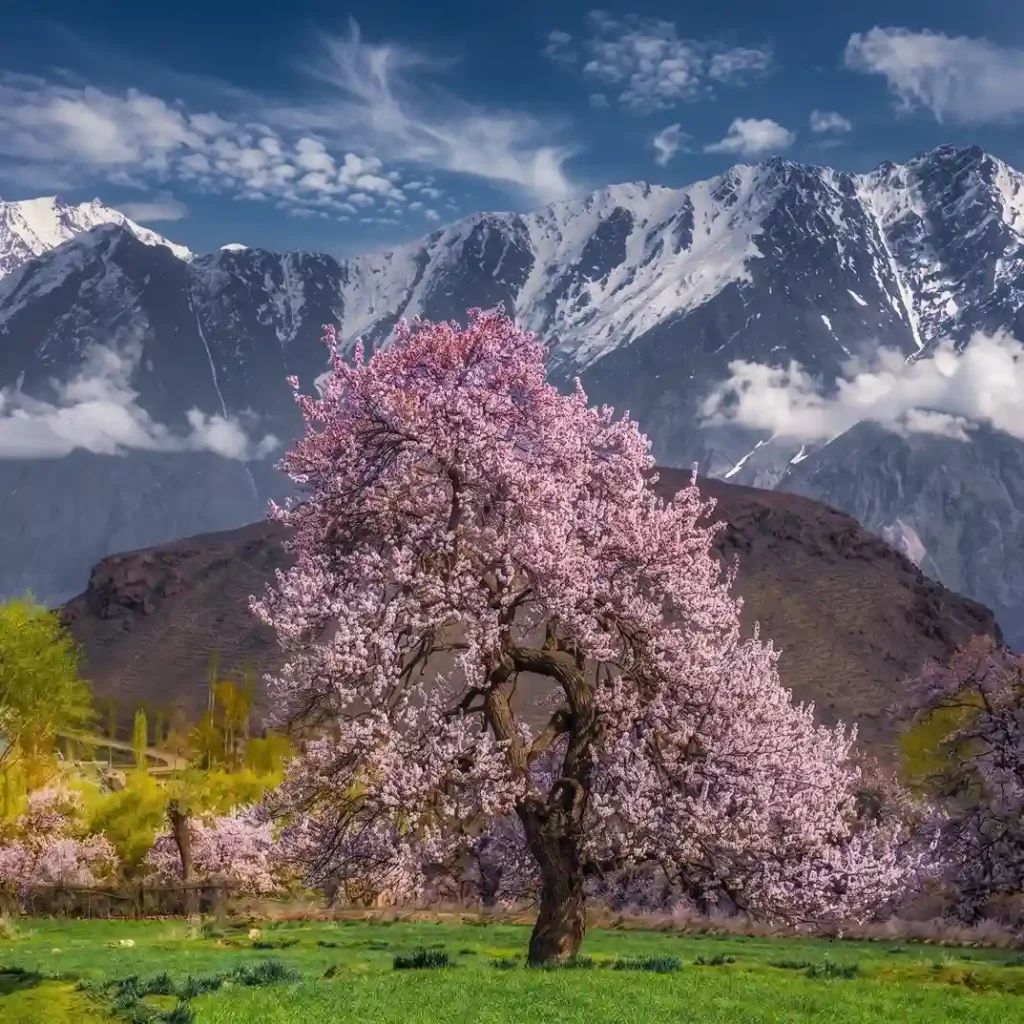
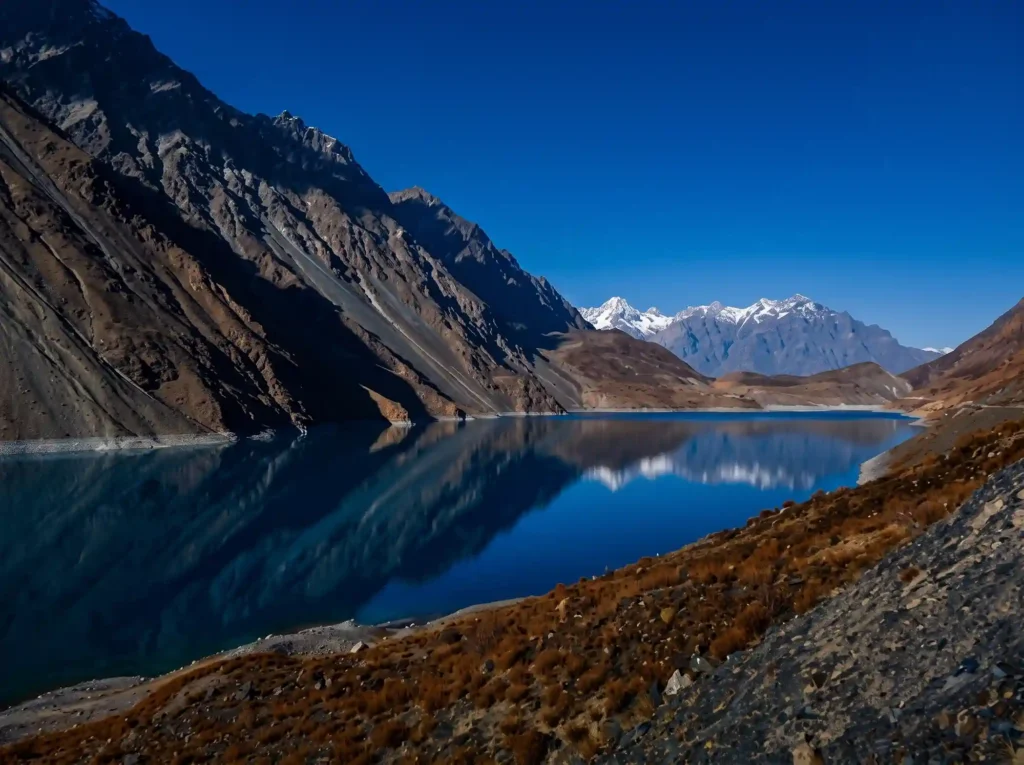
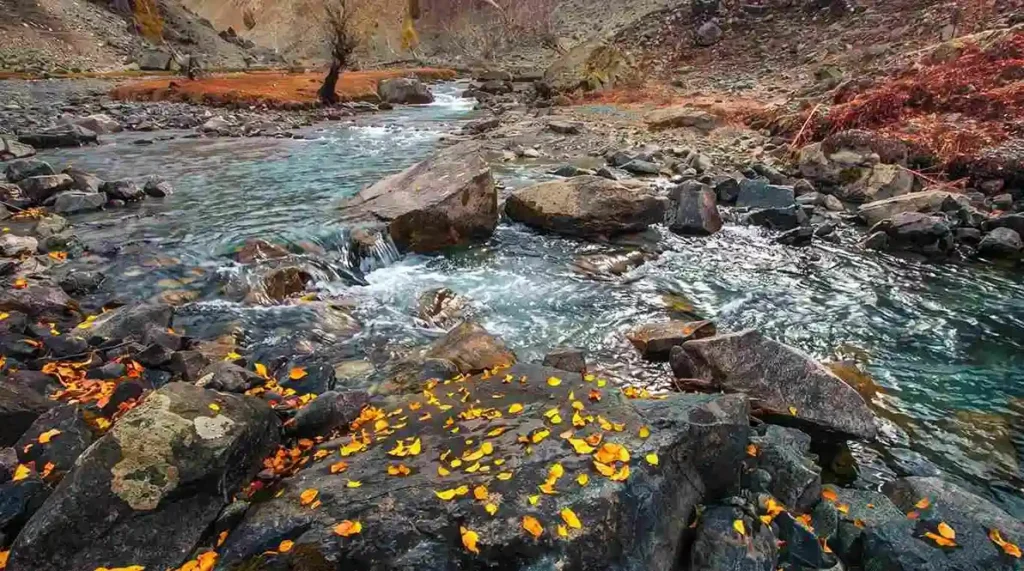
A Skardu autumn tour package takes you around the valleys of Baltistan while the poplars, willows and orchard trees turn yellow and the first snow settles on the high ridges. Ilyas Skardu Travels and Tours runs it as a private, customizable trip based in Skardu, with the route adjusted to the weather, the light and the roads each day.
This page covers what the tour includes, when the colors actually peak, how Deosai fits in (or does not), and whether to fly or drive from Islamabad. It also says plainly where nothing can be promised, because autumn in Gilgit-Baltistan changes from year to year and sometimes week to week.
If your dates are already fixed, contact the team for current availability and a written quote.
What a Skardu autumn tour covers
A Skardu autumn tour uses Skardu town as its base and reaches the surrounding valleys in day trips, with optional nights in Shigar or Khaplu.
Skardu sits at roughly 2,200 to 2,300 meters, where the Indus meets the Shigar River, and most stops are within a few hours of town. The Kachura lakes are a short drive out. The Katpana cold desert lies on the edge of town beside the road to Shigar, and the fort-palace at Shigar is about an hour further. Khaplu is a longer drive east along the Shyok River. Satpara Lake marks the start of the track toward Deosai. Manthoka Waterfall is the outlier, in Kharmang to the south-east.
The physical effort is low. Most of each day is spent in the vehicle with short walks at each stop, and the only real climb is the path up to Kharpocho Fort. The tour suits couples, families, friends, photographers and first-time visitors to Gilgit-Baltistan. Anyone hoping for a serious hike should look at the K2 Base Camp trek instead. The Skardu district page on the Gilgit-Baltistan Tourism Department site gives an official list of attractions.
Quick tour facts
| Detail | Information |
| Tour name | Skardu Autumn Tour Package |
| Destination | Skardu, Shigar, Khaplu and the Kachura lakes, Gilgit-Baltistan |
| Sample duration | 6 days, 5 nights (the company also plans formats from 4 to 8 days) |
| Tour type | Private and customizable, by air or by road |
| Flight time | About 1 hour from Islamabad, weather permitting |
| Vehicle | Private vehicle (the company’s by-air listings mention a Prado, so confirm on your quote) |
| Difficulty | Easy to moderate, with short walks and some long drive days |
| Best time | Roughly the first three weeks of October for most travelers (see the timing section) |
| Price | Varies by dates, group size, hotel grade and by-air or by-road travel. Confirm current rates before booking |
When is the best time to visit Skardu in autumn?
For most years, the first three weeks of October give the best balance of color, clear air and open roads.
Autumn in Skardu does not arrive on a single date. Some sources place the season between mid-September and the end of October, others carry it into November, and a few say the best color is over by the last week of October. The disagreement has a simple cause: color moves down the mountains as the cold arrives, so each village has its own peak week, and a warm or early-cold year shifts everything by days or weeks. Most sources agree that October is the core month.
| Window | Colors | Weather | Deosai | Worth knowing |
| Late September | Color begins. Most valleys still green | Mild days, cooler evenings | Often reachable, snow permitting | Quieter than summer. Suits Deosai fans |
| First half of October | Poplar rows in Shigar and Skardu turn yellow | About 12 to 22 C by day, 2 to 8 C at night (one local operator’s figures) | Uncertain. Closes with the first heavy snow | Clear views. Usually the best all-round window |
| Late October | Peak in some valleys, fading in others | Colder nights, early snow on higher ground | Frequently closed | More flight disruption. Some hotels wind down |
| November | Golden remnants, bare branches | Winter begins. Ask about heating | Closed | Very quiet and cold. Snow can affect roads |
If you can only pick one window, aim for the first three weeks of October and keep your dates flexible by a few days. Earlier trades some color for milder nights and a better chance of Deosai. Later trades warmth and access for bare branches, colder mornings and empty valleys, which some photographers actually prefer.
What turns gold, and what does not
Skardu autumn colors are concentrated wherever there is water. Poplars planted in rows along fields and irrigation channels turn a clear yellow. Willows follow. Orchard trees such as apricot, walnut, mulberry and apple add orange and rust to the village lanes.
The slopes above are mostly bare brown rock and scree, so the effect is ribbons of gold laid against dry mountains and early snow, not a continuous forest. That contrast is what photographs well: a yellow poplar line, a brown ridge, a white summit behind. Expect hillsides of red maple and you will be looking for something that is not there. Expect gold along the rivers and lanes and it delivers.
Recommended Tourist Places in Skardu for Every Traveler
Explore our recommended Skardu tour packages, carefully designed for solo travelers, families, couples, and groups. Choose from flexible Budget, Standard, and Luxury options to match your travel style and budget.
| Tour(s) | Mode of Transport | Budget | Standard | Luxury |
|---|---|---|---|---|
| Kharpocho Fort Skardu: History, Location, Timing and Ticket Price | By Road | PKR 90,500 | PKR 115,000 | PKR 194,000 |
| Shigar Valley Skardu: Complete Travel Guide, Attractions & Things to Do | By Air | PKR 100,500 | PKR 140,500 | PKR 220,000 |
| Blind Lake Skardu Tour: A Half-Day Trip Through Shigar Valley | By Road | PKR 9,500 | PKR 12,500 | PKR 15,000 |
| Baltit Fort Hunza: Karimabad’s Historic Landmark | By Road | PKR 20,000 | PKR 30,000 | PKR 40,000 |
| Organic Village Skardu Tour: Walk to Nangsoq | By Air | PKR 115,000 | PKR 136,000 | PKR 25,000 |
| Attabad Lake Hunza: Complete Travel Guide | By Air | PKR 130,000 | PKR 150,000 | PKR 235,000 |
| Manthoka Waterfall Skardu: A Complete Guide | By Road | PKR 168,000 | PKR 250,000 | PKR 390,000 |
Sample itinerary: 6 days, 5 nights by air
This is a sample plan, not a fixed script. The order can swap, and times move with the flight schedule, the weather and how long your group wants to stay at each stop.
Day 1: Fly Islamabad to Skardu, Kharpocho Fort and the old bazaar
Morning flights take about an hour, and PIA, Airblue and AirSial all operate the route. Take a window seat if you can, because the approach over the Karakoram is one of the better parts of the trip.
After hotel check-in, keep the rest of the day light. Most people handle Skardu’s altitude easily, but a slow first afternoon helps. Kharpocho Fort is a short drive from the center, followed by a climb on a well-made path. Go late, when the sun is low over the Indus and catches the walls. Accounts of the fort’s age differ. Most tie its main construction to the Maqpon dynasty and Ali Sher Khan Anchan, somewhere between the 15th and 17th centuries, so ask your guide which version they follow. Finish in the old bazaar with tea.
Flight cancellations are the main reason this itinerary carries a spare day. Ask how your booking handles a cancelled flight, including who pays for any extra night.
Day 2: Kachura lakes and the Katpana cold desert
Start with the Kachura lakes. Lower Kachura is where Shangrila Resort sits beside its heart-shaped lake, and it suits an easy walk. Upper Kachura is quieter, with a short walk down to the water and boating that you should confirm is running on your dates. Check whether the resort grounds are open to visitors who are not staying, and what the entry charge is. If the lakes are your main interest, see the Upper Kachura trip from Skardu
In the afternoon, drive to Katpana, which the Gilgit-Baltistan Tourism Department lists at 2,226 meters. October suits it. The air is usually clear, the sand is cool rather than hot, and the peaks behind are often dusted with snow. Bring a scarf or face cover in case wind lifts the sand.
Day 3: Shigar Valley, the fort and the poplar lanes
Shigar is about an hour from Skardu. The road crosses the Indus and runs through the Sarfaranga dunes on the way in. Fong Khar, the Palace on the Rock, was built in the early 17th century by the Amacha rulers, restored by the Aga Khan Cultural Service, Pakistan, and now works as a museum and heritage hotel. Its restaurant is a convenient lunch stop.
Nearby is the Amburiq Mosque, a wooden mosque of about the 14th century whose conservation received a UNESCO award in 2005. Then walk the village lanes instead of staying on the main road. The poplar lines and stone walls are where autumn shows best in Shigar. Return to Skardu by late afternoon.
Day 4: Khaplu, the palace and the Chaqchan Mosque
Khaplu is roughly 100 to 110 kilometers east of Skardu, and most sources put the drive at three to four hours each way along the Shyok River. Leave early. The road is open all year, though rough patches near river crossings are normal.
Khaplu Palace, also called Yabgo Khar, was restored by the Aga Khan Trust for Culture. The Chaqchan Mosque in the old bazaar dates to about the 14th century and is among the oldest surviving mosques in Pakistan. This day works far better with a night in Khaplu, which turns two long drives into a relaxed visit. Ask about adding one, which usually means a longer package.
Day 5: Deosai if it is open, otherwise Satpara Lake and Manthoka Waterfall
This is the flexible day. If Deosai is open and the forecast is clear, it is a full day on a rough 4×4 track, with the plateau reached after roughly two hours or more from Skardu. Satpara Lake is a natural first stop on the way. If Deosai is closed, spend the day on Manthoka Waterfall instead. Sources put it anywhere from about 80 to 120 kilometers from Skardu depending on where they measure from, so plan a full day. The falls drop roughly 55 meters. The next section explains why Deosai is a bonus, not a promise.
Day 6: Departure and buffer
Fly back to Islamabad in the morning. Because Skardu flights are cancelled for cloud and wind, do not schedule anything important in Islamabad on the day you return, and ask about a spare night if your dates are fixed.
Is Deosai open during the autumn tour?
Sometimes, and only for part of the autumn season. Deosai is not something to build the whole trip around.
The Gilgit-Baltistan Tourism Department describes Deosai as a summer place, and the plateau averages about 4,114 meters. Closing dates vary between sources. One local operator says the road usually closes with the first heavy snow around mid-October, another reports the last week of October, and some guides say June to September only. The closing date is decided by snowfall, not the calendar, and at least one recent year brought heavy snow in mid-October that stranded visitors.
In autumn there are no wildflowers. The plateau turns from green to golden brown, October nights can fall below freezing, and you need a 4×4 from the Skardu side. Bear sightings are never guaranteed. If Deosai matters to you, travel in late September or the first days of October, and have the team confirm road status locally before you leave Skardu. See the Deosai National Park tour and the guide to Deosai permits and fees for more.
Skardu autumn tour package from Islamabad: by air or by road?
Flying is the practical choice for most autumn trips, because the flight takes about an hour while the road takes most of two days.
| By air | By road | |
| Travel time | About 1 hour | Most sources say 16 to 22 hours with stops, usually split by a night in Chilas or Besham |
| Main risk | Weather cancellations, since flights depend on visibility | Landslides, flood damage and rockfall on the Karakoram Highway and Jaglot-Skardu road |
| Route | PIA, Airblue and AirSial fly it | Via Mansehra, Besham, Dasu, Chilas and Jaglot, open all year in normal conditions. The Babusar Pass route is seasonal and usually closes by October |
| Buffer needed | One spare day at the end | Two extra days for delays, more in bad weather |
| Best for | Short trips, young children, fixed return dates | Travelers who want the highway and have time |
Some sources quote much shorter road times, but those assume a clear run with no stops, which the Karakoram Highway rarely gives. Some travelers fly in and return by road, or the reverse, to see the highway once without committing to it both ways. Ask about that mix when you look at our Skardu tour packages from Islamabad.
What the 2026 monsoon showed about road planning
Anyone planning a Skardu autumn tour in 2026 should know that mountain roads here change quickly. In late July 2026 the Jaglot-Skardu road was closed for several days after flood damage to a bridge near Sassi Haramosh. It reopened once a temporary bridge was in place, as noted in the Gilgit-Baltistan Tourism Department’s road notice. Local reports in early August described further closures on the Babusar road and part of the Karakoram Highway after flash floods.
Autumn is normally drier than the monsoon, but a road that was clear last week can be blocked today. Check road and flight status two or three days before you leave, and again on the morning of travel.
What a Skardu autumn tour package costs in 2026, and what changes the price
The price of a Skardu autumn tour package depends on how you travel, how many nights you stay and which hotels you choose, so a single printed figure would mislead you.
| Factor | How it changes the price |
| By air or by road | Air packages carry the airline ticket. Road packages carry more vehicle days and nights on the way |
| Number of nights | Formats run from 4 to 8 days, and each extra night adds hotel and vehicle cost |
| Hotel grade | Standard, deluxe and executive options exist. Heritage hotels in Shigar and Khaplu cost more than town hotels |
| Vehicle | A Prado costs more than a larger shared van |
| Group size | Cost is shared across the vehicle, so a group of four often pays less per person than a couple |
| Travel dates | Airfares change daily and can rise around busy dates, so price weekends and holidays separately |
Prices and hotel availability change during the season, so treat any figure you see online as a starting point. Send your dates, group size and hotel preference, and the team can price the trip on current rates.
How difficult is a Skardu autumn tour?
A Skardu autumn tour is easy to moderate. The demanding parts are long road days and the cold, not the walking.
Most days involve sitting in a vehicle and walking for 10 to 40 minutes at each stop. Kharpocho Fort is a short climb, and Shigar and Khaplu mean uneven village lanes. Skardu’s altitude suits most healthy travelers, but Deosai sits above 4,000 meters, where headaches, breathlessness and nausea are more likely. Ascend gradually, drink water, and tell your guide early if you feel unwell. This is general guidance, not medical advice, so anyone with a heart or lung condition should ask a doctor before planning Deosai.
Families with young children or older relatives usually do best with the Khaplu overnight instead of a same-day return.
What to bring for autumn in Skardu?
Skardu in autumn is colder than many first-time visitors expect. Days are mild in the sun, but mornings and evenings drop sharply, and Deosai and the high villages are colder still.
- A thermal base layer, a fleece and a windproof jacket. Layers work better than one heavy coat
- A warm hat and gloves for early starts and evenings
- Sturdy shoes with grip for fort paths, village lanes and dunes
- Sunscreen, sunglasses, lip balm and a scarf. The air is dry, the sun is strong, and wind lifts sand at Katpana
- A power bank and spare camera batteries, since cold drains them faster
- Enough cash for Shigar, Khaplu and small shops, because card and ATM access is limited outside town
- Your original CNIC (or passport) and any regular medication
- An offline map, since signal can drop between valleys
Important travel information
Documents and permits
Pakistani travelers should carry their original CNIC. The valley circuit in this itinerary does not normally need a special permit for Pakistani nationals, but rules change and some areas are restricted, so confirm with the team and the Gilgit-Baltistan Tourism Department before you travel. Foreign nationals should ask about documentation early. Deosai has an entry fee and registration at the checkpost, and the amount varies, so confirm the current rate.
Roads, weather and flights
Weather and road conditions decide the day. Skardu flights operate in visual conditions and are cancelled for cloud and wind more often as winter approaches, so keep one spare day. If you travel in late October or November, ask each hotel about heating, since central heating is not standard. Emergency numbers listed by the Gilgit-Baltistan Tourism Department include the Tourist Police on 1422, the Gilgit-Baltistan Police on 15 and Rescue on 1122.
Phones and connectivity
Signal is generally workable in Skardu town, Shigar and Khaplu but patchy between valleys, and often absent on Deosai. The regional operator SCOM tends to reach remote areas better than the national networks, so carry a second SIM if staying connected matters.
Photography and respect
Ask before photographing people, especially women, and dress modestly at mosques. Ask the team before flying a drone, since rules can change and some areas are sensitive.
How to book your Skardu autumn tour?
- Send your preferred dates, group size, hotel grade and whether you want to fly or drive.
- Receive a written itinerary and quote that names the hotels, vehicle and inclusions.
- Confirm the booking, and ask how flight cancellations and road closures are handled.
- Check road and flight status two to three days before departure.
To book a Skardu tour package in autumn, [contact the team] (INTERNAL LINK 8). [Insert phone, WhatsApp number and email from your contact page here.]
Related tours and add-ons
If your dates allow an extra day, ask about adding the Soq Valley day trip or the Marsur Rock excursion, and check what the road and light are like that week. You can also compare this trip with the other Skardu tour packages.
Tour Highlights
- Shigar Fort (Fong Khar) and the Amburiq Mosque, in a valley where the poplar groves turn yellow through October
- The Katpana cold desert dunes at about 2,226 meters, with early snow on the peaks behind
- Upper and Lower Kachura lakes, and the lakeside walk at Shangrila
- Kharpocho Fort above the Indus, with a view over Skardu town
- Khaplu Palace and the old Chaqchan Mosque on the Shyok River
- Satpara Lake, the Deosai plateau when the road is open, or Manthoka Waterfall as the alternative
Included
- Airport pickup and drop-off at Skardu
- Hotel accommodation for the nights in your itinerary
- Daily breakfast (other meals depend on the package)
- A private vehicle for transfers and sightseeing
- Guided sightseeing along the agreed route
- Air tickets on by-air packages (the company describes these as included, so confirm this for your quote)
- Phone support during the trip
Excluded
- Personal expenses such as shopping, laundry and extra drinks
- Park fees, entry tickets and optional activities (Deosai fees are paid at the check post and vary)
- Travel insurance
- Extra nights or rebooking costs caused by cancelled flights (ask how this is handled)
- Tips for drivers and guides
Gallery